
11 | Strategy: where to play and how to win

Who this post is for: Leaders who sense that their strategy rarely settles the hard questions, such as which customers to pursue or which projects to drop.
TL;DR:
- Start with a winning aspiration: what does winning mean for you? One statement, with numbers (proposal: market share, margin)
- Define where to play, your field: geographies, products, customer segments, channels, value chain stages; decide where you will not play
- Figure out how to win: why customers choose you, in a way that pays for you and that is difficult to copy; the hardest of the three questions
- Make where to play and how to win choices together: a field is only worth something if you can win on it, and a way to win is closely linked to a field
- Write it down so people can see, understand and act on it: winning aspiration, where to play and how to win, plus what you chose not to do
A large automotive customer asks for a custom version of your product. It would be by far the biggest deal in your company's history. It would also tie up many of your engineers for months (more likely years) on special versions for one customer instead of your own platform. Two or three deals like this, and you have turned into a contract engineering shop for a handful of large customers, far from the product company you wanted to be.
Your leadership team opens the strategy document to settle the question whether to go for this deal or not. It says you want to be the leading provider in attractive growth markets, through customer focus and innovation. It is so generic that it does not really help you decide anything. So the issue is decided by whoever argues hardest. And with the next large deal, the same debate starts again.
"The essence of strategy is choosing what not to do." – Michael Porter
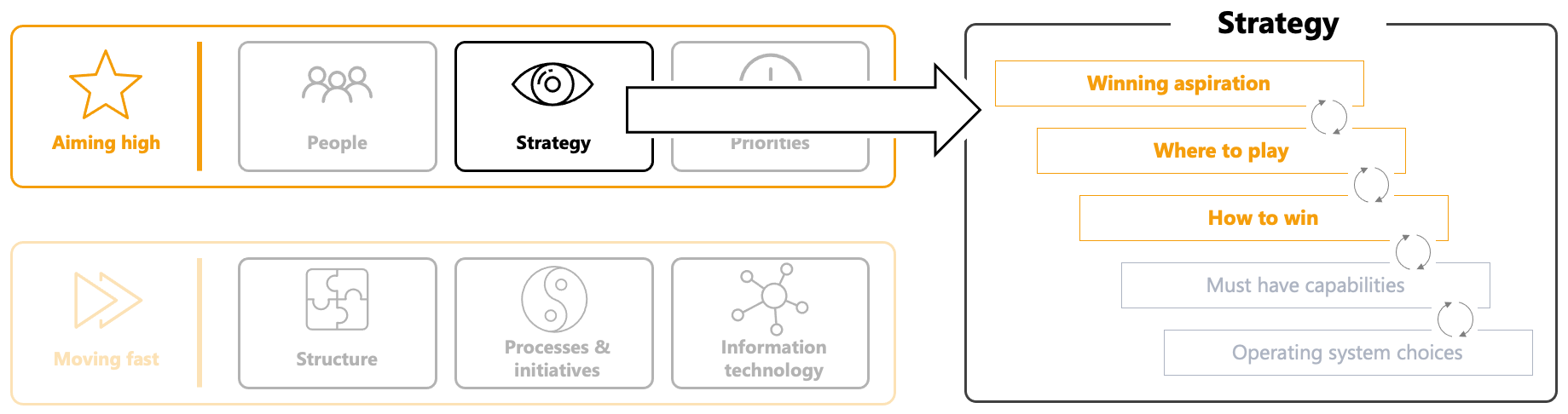
In the last post, we looked at what a strategy is. In this post, we look at its first three choices: what winning means for you, where you play and how you win. Answered well, these three questions let you decide situations like the one above once, in your strategy, and not again with every new deal.
The winning aspiration
When working on your strategy, start with what winning would look like for your organization. Without that, you cannot judge any of the other choices. Aim to win, not just to participate: as the last post showed, almost all value goes to the winners.
Write one statement, and do not allow competing statements under other names, such as a purpose. One aspiration is hard enough to reach. Several will pull your organization in different directions.
I like how A. G. Lafley, former CEO of P&G, describes the structure of a good winning aspiration: "winning with those who matter most against the very best". Before you write this off as generic, here is what it implies:
- Focus outward on the most important customers and the very best competitors, not inward on your own products and innovations.
- Start your statement with your customer rather than shareholder value. As Peter Drucker put it: the purpose of a business is to create a customer.
- Define the business you are in by the job rather than the product. In Theodore Levitt's words, people do not want a quarter-inch drill, they want a quarter-inch hole. A product definition keeps attention on engineering instead of on customers.
- Define winning against your best competitor, not against your own past. "Grow 20% a year" can be reached while falling further behind.
Make your winning aspiration tangible by adding numbers. I propose a market share target (for the playing field you chose, not for a market you cut so small that you already lead it), plus a margin target. Share shows that customers choose you over the alternatives. Margin shows that you can turn this into value for you.
Do not perfect your winning aspiration upfront: draft it, move on to where to play and how to win, and iterate until the three fit.
The heart of strategy
The questions of where to play and how to win form the heart of strategy. They are so closely linked that you need to decide them together. A common mistake is to go through them sequentially: locking in a playing field, and only then asking how to win on it.
My favorite version of this argument comes from Hamilton Helmer, economist and author of "7 powers". To him, the purpose of strategy is value creation, defined financially (net present value, for those interested). He shows that it comes down to two factors multiplied with each other: market scale and what he calls power.
Market scale is the size of the market and how fast it grows. Power is how much of it you hold, at a margin your competitors cannot take away. Where to play defines the first term, how to win shapes the second. Both are multipliers, so either one at zero makes the result zero. An attractive field is worth nothing to you if you have no way to win on it. And a way to win only works on the field it was built for, against the competitors you meet there. A company of 100 people can be the scale leader in a narrow niche, and a nobody in a broader market.
What I like about Helmer's view: it makes strategy tangible. In the end, good strategy has to show up in numbers, as share and margin on a field big enough to achieve your winning aspiration.
Where to play
Where to play defines the field you want to compete on. You can think about it along five dimensions, shown here with the choices of Vektor, a fictional company making force-torque sensors for industrial robots (the example from the last post's template):
- Geography: which countries or regions. Vektor: Europe and China, not North America.
- Product types: which products and services. Vektor: sensors for collaborative and light industrial robots, not heavy industrial ones.
- Customer segments: which groups of customers, with which needs. Vektor: electronics assembly as its core, extending into medical device assembly, not automotive.
- Channels: how you reach your customers. Vektor: directly to robot makers, with its own engineers in their teams, no distributors.
- Value chain stages: which steps of the value chain you cover yourself. Vektor: sensor plus the firmware embedded in it, no application software.
When you decide where to play, be equally explicit about where not to play. Excluding nothing is a more common mistake than picking the wrong field. Leaving things open feels more flexible and safer. But then money, people and attention get spread across every field, and you end up too weak to win on any of them. Look critically at the fields you are already in, too: exiting a field is emotionally harder than not entering one, so questioning them is done much less often.
While staying focused is important, the field still has to be large enough for your winning aspiration. That depends on its market scale and on how much of the value it creates the companies in it can keep. Michael Porter's five forces show what takes value away from them: powerful buyers and suppliers, substitutes, new entrants and the rivalry among the companies themselves. Where several of these forces are strong, even the best companies earn little.
You can extend your field over time, but establish a strong core first. Chris Zook of Bain found that only about one in four attempts to grow outside the core business succeeds, and that the odds fall with every step away from it. So extend into adjacencies: fields next to your core, where you can build on your existing customers, products or capabilities. A practical rule: change one dimension of your where to play at a time (a new customer segment, or a new geography, or a new channel), not several at once.
How to win
How to win is usually the harder question: unlike where to play, it has no clear dimensions to work through. I find it helps to break it into three parts: preference, advantage, and power.
Before anything else, how to win is about preference: the reason a customer on a field prefers you to everything else available to them. This is the core of Roger Martin's definition from the last post: strategy compels desired customer action. So write how to win from the customer's side: what do they get from you that they cannot get elsewhere? Technology companies in particular tend to fill this part with features and technologies, because that is what they work on every day. But a feature only counts if it gives customers a reason to choose you over the alternatives. For Vektor, "auto-calibration algorithms" is a feature it builds. "Integrators save days of commissioning due to auto-calibration" is why customers choose it. The first belongs on a roadmap, the second in how to win.
Second, how to win is about advantage: customer preference only helps you if it leaves you better off than your competitors (in financial terms, with a higher margin). There are two ways to get there: create the same value more cheaply than others (Porter's cost leadership), or offer something customers value that others cannot match, and charge more for it than it costs you (differentiation). The choice has consequences: if you prioritize cost, standardize products and processes and give up on customers who do not fit. If you prioritize differentiation, understand one customer group better than anyone, and get paid for what you do for them.
Do not confuse cost with price. Cutting your prices to win market share does not make you the cost leader. Being the cost leader means it costs you less than your competitors to create the same value for customers. That gives you margin they do not have. You can use it to lower your prices, but you do not have to. You can also keep your prices and earn the higher margin, or invest it, for example in development.
A common failure mode is doing a bit of both and ending up stuck in the middle (Porter's term), with neither cost leadership nor real differentiation. Another is paying for customer preference out of your own margin, for example with more custom engineering or faster support without a change in price.
Third, how to win is about power. Margin attracts competitors, so you need to be able to defend it. Helmer calls this power (others use "sustainable competitive advantage"): an advantage plus a moat, something that stops competitors from taking the advantage away. Advantages are common, moats are rare. Across about 400 strategy cases (his own and his students'), Helmer found only seven types of power:
- Scale economies: Your cost per unit falls as your volume grows, so a smaller rival cannot match your price without losing money.
- Network economies: Your product is worth more to each customer the more customers use it, so a rival with fewer customers cannot catch up.
- Counter-positioning: You use a new, better business model that the incumbent will not copy, because copying it would damage its existing business.
- Switching costs: Your customers would lose something (data, integration, training) by moving to another supplier, so a rival has to make up for that loss.
- Branding: Customers pay more for your product than for an objectively identical one, because a brand is performance remembered, and a rival cannot buy that memory.
- Cornered resource: You have access, on good terms, to something valuable that others cannot get, such as a patent or a key team.
- Process power: Years of improvement have given you ways of working that lower your cost or improve your product, and a rival needs years to match them.
Not every power can be built at any time. Cornered resource and counter-positioning belong to the early days of an industry: you secure the resource or invent the business model before sales take off. Scale economies, network economies and switching costs can only be built while your market grows fast (roughly 30 to 40% a year or more, according to Helmer). Branding and process power take many years, so they come once the market has settled. So first be honest about your market's phase, then look for the powers you can still build.
Roger Martin suggested adding an eighth power: a configuration of choices that "individually wouldn't create a sustainable advantage, but together does", because a competitor would have to copy all of them at once. In my view, for many companies, this is the most realistic path to power.
One last point: sometimes nobody can create power in a market. Advantages get copied fast, price becomes the only variable, and margins shrink for everyone, the strongest players included. If that is your field, you may want to look again at your where to play.
To make this concrete, go through your how to win choices and ask three questions:
- Does it name a reason why a customer would choose you? "Modularize the software" or "train the sales force" do not. "Medical device makers can skip recalibration, because our sensors stay accurate when the temperature changes" does.
- Does it pay for you? If the reason customers prefer you costs you more than it earns, you are buying preference and do not yet have a way to win.
- What stops your best competitor from copying it within two years? It must be something they either cannot copy, or will not copy because it would hurt their own business. To create power, you need to be able to name your moat.
Things that often go wrong
Real choices take courage, so it is tempting to put something easier in their place. Three substitutes are common:
- The roadmap: product lines presented as playing fields and feature lists of future versions listed in how to win. But features are things you build, not reasons customers choose you, and on their own they rarely create power.
- The business case: the aspiration becomes a revenue target, and the playing fields become spreadsheet rows whose only purpose is to add up to that number. Among all the (made up) numbers, not a single thought on how you win with your target customers.
- The rambling wish list: every unit's favorite playing field and every stakeholder's pet project ends up on the page, so nothing gets chosen, nothing gets opted out of, and nothing fits together.
Writing it down
The choices only help if they are written down, so that people can see them, understand them and act on them. I propose one page that holds four things:
- The winning aspiration, with the numbers that make it tangible.
- One where to play with its how to win, or a few. For most companies, one is enough. Two or three make sense if you are extending into an adjacent field, or if you really are a set of different businesses. Vektor has two: its core in electronics assembly, and the step into medical device assembly.
- The resources behind each of them. The money and people you put behind each, and the profit you expect from it. Without that, nobody can tell a real choice from a wish. Look at the period your strategy covers (I like three to five years), not only at the coming year, otherwise it turns into a budget.
- What you chose not to do. Fields you will not serve, customers you will turn down, and the internal things you stop. Each of them should free money or people that you can then put behind your choices.
The template below has space for all of this. Its second slide shows Vektor's page.
Making strategy real
We have now looked at the three choices about the world outside your organization. What we have not yet touched on is whether you can make your strategy real: your capabilities and your operating system choices. We will cover these two internal choices in the next post.
The same choices apply at every level, from company to team, and with some adjustments to functions. The details on that deserve their own future post.
Further reading
- Playing to win by A. G. Lafley and Roger Martin: My favorite book on strategy. Chapters 2 to 4 cover the winning aspiration, where to play and how to win in more depth.
- 7 powers by Hamilton Helmer: A great book on sustainable competitive advantage (power). It outlines seven types of power and when in a market's life each one can be built.
I value feedback. If you see something worth challenging or improving, feel free to reach out on LinkedIn. I treat these posts as living documents and will update them over time.