
10 | Strategy: what it is, and how to tell if yours is any good

Who this post is for: Anyone who wants to better understand what a good strategy looks like.
TL;DR
- A strategy is an integrated set of choices that compels desired customer action (Roger Martin's definition). It is not the same as a vision or a plan
- Test every statement: if the opposite is stupid, it is not a strategy choice; what fails the test can still be important, but will not differentiate you
- Play to win, because not doing so will make you lose: you will not take the tough decisions required for winning, and the gains go to the few who do
- The five strategy choices: what winning means, where you play, how you win, what capabilities you need, and how to set up your operating system
- Those five choices are interdependent, need regular revision, and apply to a company, a business unit, a function, and a team
I started my work life with some skepticism about strategy. To me, it always seemed that there are many roads to Rome and that the much more important part is actually walking the path you chose. I felt that this follow-through is missing in many places: companies, governments, schools, friend circles, individual lives. You decide to do "A". Then along the way you also pick up "B" and "C", because that felt like a good idea. Later you check on where things stand, and you realize that, well, you did not get very far on "A". But hey, you at least got "B" and "C" done. But "B" and "C" never were the point. "A" was.
I still find it crucial that an organization is able to do what it said it would do. Because without that, what you say loses all meaning. But I came to believe that choosing what to do matters just as much: once you can follow through, this choice decides your outcomes. It is entirely possible to move with focus and speed straight into a dead end.
"There is nothing so useless as doing efficiently that which should not be done at all." – Peter Drucker
I owe most of this change of mind to Roger Martin (thanks to his great book playing to win and his very sharp blog). His way of making strategy concrete, testable, and implementable finally made strategy useful to me.
In this post, we will look at what a strategy actually is and how you can test whether yours measures up.
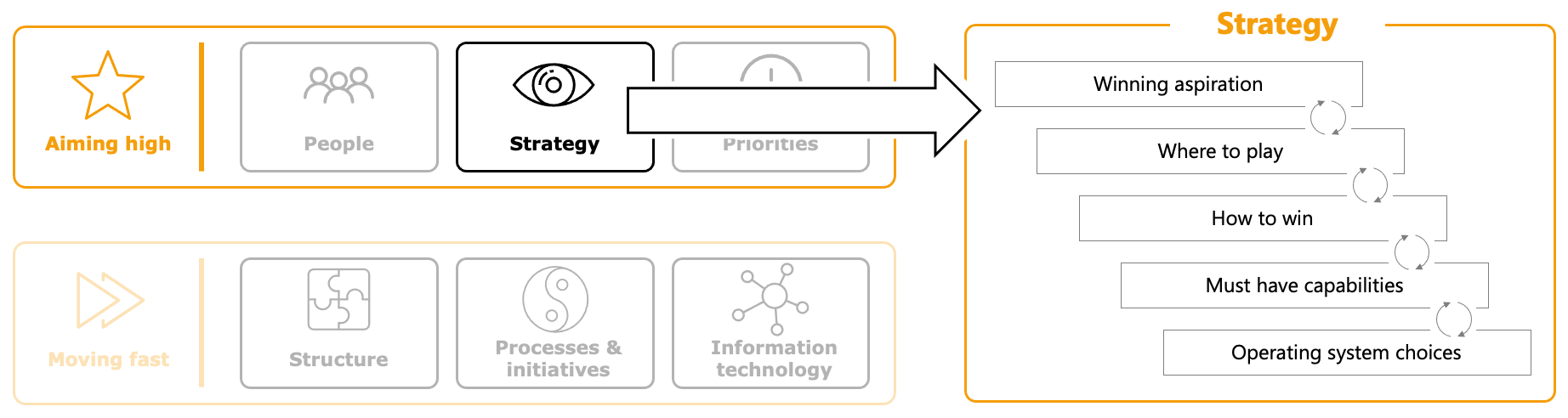
What strategy is
I like Roger Martin's definition:
Strategy is an integrated set of choices that compels desired customer action.
Three things in that sentence need highlighting:
Strategy is about choice. Decisions to do some things and not others. If nothing is being given up, nothing is being chosen. Seems obvious, and yet it is where many strategies already fail.
Choices need to be integrated. The strategy choices made need to fit together and reinforce each other. Five sensible statements pulling in different directions are a list, not a strategy.
Strategy is aimed at what you do not control. You decide how many people you hire, what product to build, where to set up sales offices. You do not get to decide whether a customer buys from you. Strategy is arranging what you control so that the thing you do not control happens: enough customers buying at prices that work for you.
What strategy is not
It is worth contrasting this definition with three things that are unfortunately quite popular strategy replacements.
#1: Nothing. Not by accident, but on purpose. The argument goes that the world moves too fast for strategy to be worth the effort, so it is better to stay flexible and respond to opportunities. This is popular in tech companies and start-ups, which indeed often face fast-moving markets. But it leaves you permanently reacting to what is happening, pushing you further into the reactive mode that scaling organizations often already struggle with. This also makes you vulnerable to competitors who made their choices, and who are now investing heavily in winning on the playing field they picked, while you keep jumping from one thing to the next.
#2: A vision or a mission. This is absolutely worth having, but it is not a (complete) strategy. A statement of what you want to become tells nobody what to do differently, and contains no choice about which customers you are trying to win.
#3: A plan. This is the most common substitute for strategy and is often quite convincing, because a plan looks like work. However, planning is about laying out initiatives, setting goals, and allocating teams and resources. That is good to know, but it is not strategy. People often prefer planning over strategy because it is more comfortable. A plan can say yes to everything. A good strategy, on the other hand, hurts. It creates choices which translate into telling colleagues that what they have been working on is not where the company is heading. That can be very uncomfortable, but it saves lots of effort and disappointment down the road.
Planning is what goals and the operating rhythm are for. But this post is about strategy.
A simple test for your strategy
If you already have a written-down strategy, run the following test to get a feel for its quality:
If the opposite of a statement is stupid on its face, it is not a strategy choice.
That is the whole test. Take each line, state the opposite, and ask whether any sane company would choose it. If not, your statement was never a choice, because nobody was ever going to decide otherwise.
A few examples:
- "We deliver high quality products." The opposite: we deliver low quality products. Nobody picks that. Not a strategy choice.
- "All our products are certified to [industry standard]." The opposite: we ship products that do not meet the standard our industry requires. Not a strategy choice.
- "We serve industrial equipment makers, not consumer device makers." The opposite is a real position that other companies can take deliberately. This is a strategy choice.
- "We sell through distribution partners only, never direct." The opposite is a real position. This is a strategy choice.
- "We are the lowest-cost producer in our segment." Also a strategy choice, and a very demanding one, because there is only one lowest-cost producer per segment.
You may find that only a few statements survive this test.
Some of what the test removes is genuine fluff ("leveraging our synergies", "leading provider", "partner of choice"). But many things that fail the test are actually really important to your organization. Quality. Safety. Solvency. Martin calls these "operating imperatives": things you must do well, and that everyone in your industry must do well, so doing them will not differentiate you.
Put them on a separate list, and handle the two lists in opposite ways. On operating imperatives, copy shamelessly ("benchmarking"): find whoever does it best and replicate it, because originality buys you nothing here. On your strategy choices, copying is not only unhelpful, it will actually harm you. Here, you need to focus on differentiating from your competitors, because a customer only has a reason to prefer you if you have something the others do not.
Playing to win
The test above tells you whether a statement is a strategy choice. It does not yet tell you whether it helps you win with customers. Customers only buy from you when they prefer you to everything else available to them.
This is where "playing to win" becomes central. It goes far beyond strategy and is squarely about mindset. The common alternative, "playing to play", sounds like:
"This is a huge market. If we get to a five percent share, that is a serious business."
"We have great products and loyal customers. We are happy with that."
Both are reasonable statements at first glance, and I have heard them said in good faith by capable people. But both describe a company that has decided not to win.
The problem with this mindset is that it only works as long as every competitor shares it, and no market stays that way for long. Somebody will decide to play to win, and that will soon show up in the choices they are prepared to make (and you are not). Killing a product line that still earns money, because it does not fit the direction. Funding an important future bet through a bad year, when cutting would have been easier to justify. Such choices face huge resistance, but they compound, and after a few years, the gap becomes almost impossible for anyone else to close.
When you "play to play", you spread your resources across non-choices, which will create average outcomes. McKinsey's "power curve" shows what "average" leads to: across ~2,400 companies, the top 20% created close to 90% of all economic profit. The middle 60% barely covered their cost of capital, and the bottom 20% destroyed value outright.
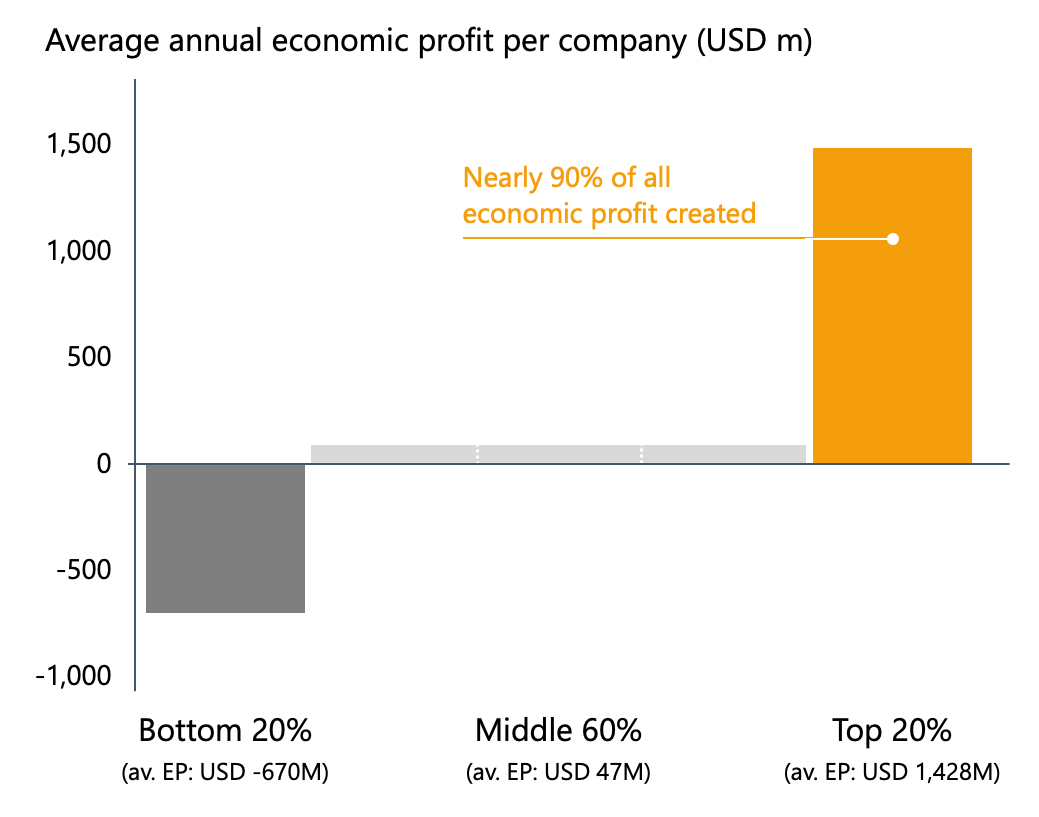
Five percent of a market does not buy you five percent of the winnings. It buys a seat in the flat middle, where thousands of competent, hard-working companies capture close to no value.
What makes the "playing to play" mindset dangerous rather than just modest is that it feels fine long past the point of no return. You may hit your (too modest) targets for years, while your position erodes underneath you. There may be no bad quarter to point at. Until one day you find that the customers who used to be yours have found somewhere better to go.
There is also a happier reason to play to win. The best phrasing I know comes from a football coach I had as a kid: of course football has to be fun. But it is a lot more fun when you win. That is it. Winning is exciting, energizing, empowering. It funds what you want to do next, it attracts people who want to win with you, and it makes the hard parts feel worth it. It is not more virtuous or modest to aim lower, and it is a lot less fun, too.
So play to win. You may still lose, because winning is hard. But "playing to play" will never make you take the tough choices that would make winning possible.
The five choices
If strategy is an integrated set of choices, the obvious question is: choices about what?
Roger Martin's answer is a set of five questions: the strategy choice cascade.
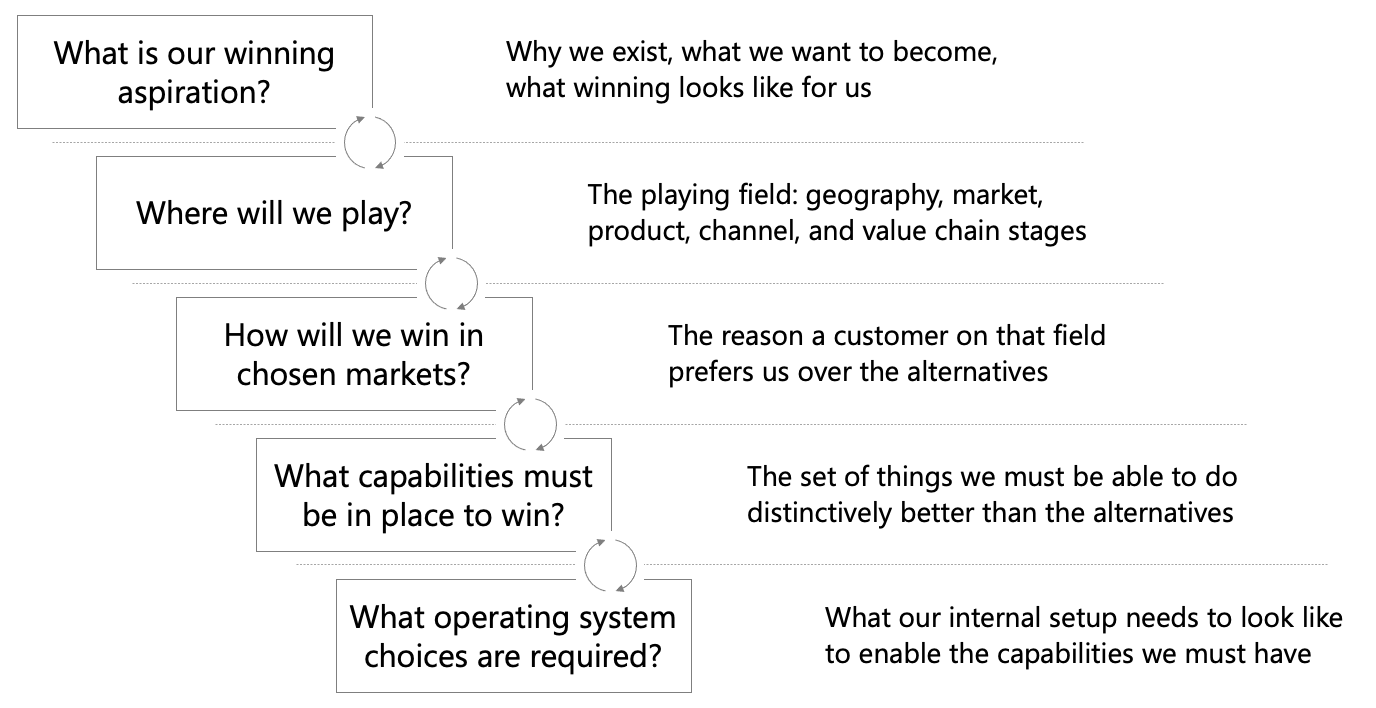
The first three are choices about the world outside your company: what you are trying to become, who you serve, and why they pick you. The last two are choices about your own organization: what it needs to be able to do, and how it has to be set up to do it.
One deviation worth flagging: Roger Martin calls the fifth box "enabling management systems". I label it "operating system choices" instead, because what determines whether your organization can produce a capability goes beyond management processes. It is also about who you hire and promote, what you set as goals and what you measure, how you group people and where decisions are made, how you run repeatable work and projects, and what data and tools people work with. In other words, this box is where strategy meets the rest of your operating system.
The template below puts the five choices on a single page, with room for operating imperatives underneath. The second slide shows an example based on Vektor, a fictional deep-tech scale-up making force-torque sensors for industrial robots.
In the next three posts, we will work through these choices. First the three choices about the world outside your organization. Then the two choices about your own organization. And finally a post on how to actually make strategy choices.
Three additional characteristics
Next to the five choices themselves, there are three more things that are quite crucial to understand to create a good strategy:
The choices are interdependent: They have an order because you need to start somewhere, but no box is really first or last. If you cannot build the capabilities a how-to-win choice needs, adjust and iterate until the two fit. Your starting position matters too: how the organization is set up today shapes what it can realistically become.
Strategy is iterative: Nobody gets these choices right on the first attempt, and no set of choices stays right for very long. Markets and competitors move, and what you learn from customers feeds back into the choices. I believe it is best to revisit the cascade on a fixed rhythm (e.g. twice a year). If you run an operating rhythm similar to what I outlined here, this activity fits well into beat 2. The goal in most sessions will not be to rewrite the strategy completely, but to refine choices so they become better than the ones you had before.
It happens at every level: The same five questions apply to a company, a business unit, a function, and a team. What differs is the scope of the choices and the constraints you inherit. A team lead deciding which internal customers to prioritize and what capabilities to build is doing the same thing the CEO is doing, just within a smaller playing field.
Choosing and doing
Two things decide where an organization ends up: what it chooses to do, and whether it can actually get it done. Both matter to a high-performing organization. An organization that cannot follow through never gets anywhere. An organization that follows through on the wrong choices does not get to great places either.
In the next post, we will look in more detail at the first three choices: what winning means for you, where you will play, and how you will win with your customers.
Further reading
- Playing to win by A. G. Lafley and Roger Martin: In my view the best book about what strategy is and how to make it actionable.
- Roger Martin's blog: The place where Roger Martin keeps sharing his evolving view on strategy weekly.
- Good strategy / bad strategy by Richard Rumelt: Widely read and deservedly so, though it comes to very similar conclusions to "playing to win", which I find more hands-on.
I value feedback. If you see something worth challenging or improving, feel free to reach out on LinkedIn. I treat these posts as living documents and will update them over time.