
12 | Strategy: must-have capabilities and operating system choices

Who this post is for: Leaders who know where they want to play and how they want to win, but struggle to translate that into how their organization works.
TL;DR
- Must-have capabilities are the three to five things you need to be able to do better than any competitor to win where you play
- Make them concrete: start from why customers choose you and ask "how do we do this, uniquely?" until the answer is specific to you
- Operating system choices make a must-have capability part of "how we do things around here"; no single hire, training or process is enough
- You have several must-have capabilities, but only one operating system: their choices have to fit together, which is hard to build and hard to copy
- Write it down as a blueprint, then start with your weakest must-have capability and build what is missing
Your leadership team has agreed on a key part of how you want to win: by being closer to your customers than anyone else in your market. You hire a Head of Customer Success, and everyone goes through customer focus training. Six months later, your developers have still not met a single customer, and a customer with a problem still gets a ticket number, not a person. None of your customers has noticed a difference.
The hire and the training were not wrong, perhaps even necessary. They were just not sufficient: to be closer to your customers than anyone else, your whole organization has to be able to do things it cannot do today. Those are capabilities.
The last post covered the three strategy choices about the world outside your organization: the winning aspiration, where to play and how to win. In this post, we look at the two choices about your own organization that make them real: your must-have capabilities and your operating system choices. Your operating system is how your company is set up to work: its people, strategy, priorities, structure, processes & initiatives and information technology.
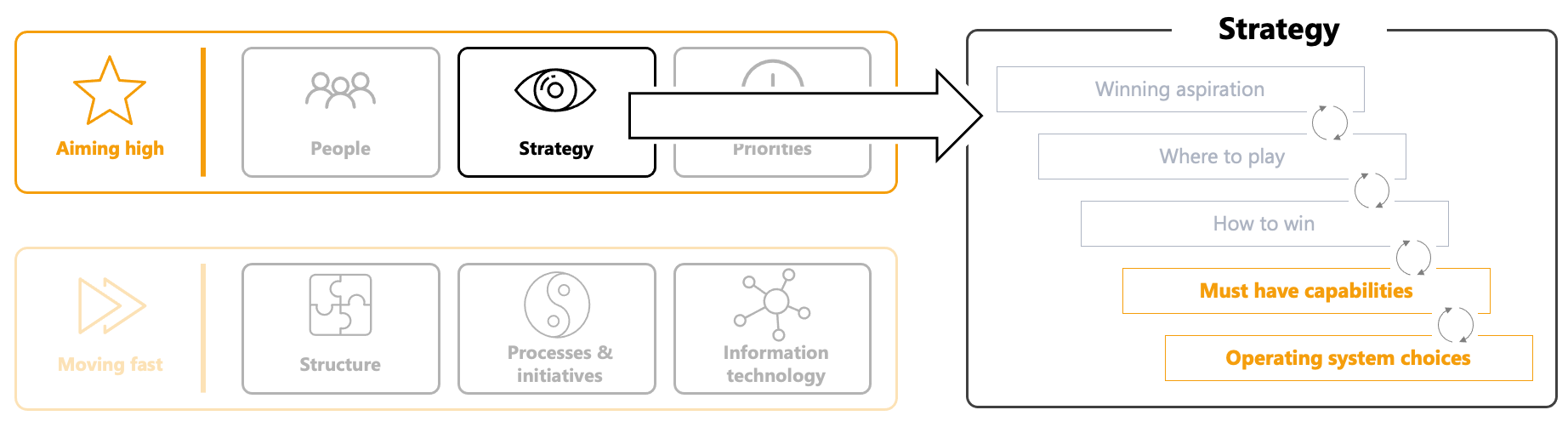
What a must-have capability is
A must-have capability is something your company needs to be able to do, and do better than any of your competitors can. Your company has many capabilities: things it can do as an organization. But only a few of them set you apart from your competitors and make you win where you play. Those are your must-have capabilities.
I have struggled with capabilities for a long time. To me, this is the most abstract of the five strategy choices. Where to play is very concrete: geographies, products, customer segments. How to win is about why customers choose you over the alternatives. Operating system choices are concrete again: what goals you set, which KPIs you watch, which processes matter. A must-have capability is much harder to pin down.
What helps me is to describe a must-have capability together with its two neighboring choices:
- What customers notice: the benefit from your how to win.
- What you need to be able to do: the must-have capability.
- What makes it possible: your operating system choices (which we look at further down).
As an example, take Zara, the clothing chain, as it worked in the early 2000s. What customers noticed was that the store looked different every week. New items arrived all the time, and a piece they liked could be gone two weeks later. That made a visit exciting and urgent. That was Zara's how to win. What Zara needed to be able to do to make this happen: bring a new design into its stores within a few weeks, while designers elsewhere spent months planning the next season. That was Zara's must-have capability.
When you think about your own must-have capabilities, there are two traps you should try to avoid. First, they have to be something you do, so "we own important patents" or "we have a great CTO" is not a must-have capability yet. Patents expire, and what you need is the ability to keep coming up with things worth patenting. Second, they have to be specific and concrete: "customer focus" or "quality" could be on any company's list and say little about what you need to be able to do.
How do we do this, uniquely?
Must-have capabilities are also a test for your where to play and how to win. If you cannot build them from where you are today, you do not yet have a working strategy. The five strategy choices influence each other, so you iterate through them until they fit together.
Start from the reason customers choose you (your how to win), and ask what you need to be able to do to make this happen. Then look at what you are already good at, because that shapes what you can realistically build. Go back and forth between the two.
You do not have to start from scratch. Chris Zook and James Allen looked at about 200 businesses and found that what set them apart fell into 15 basic capabilities and assets. I find this list a good overview of the option space, especially for technology companies, where product and IP usually dominate the thinking.
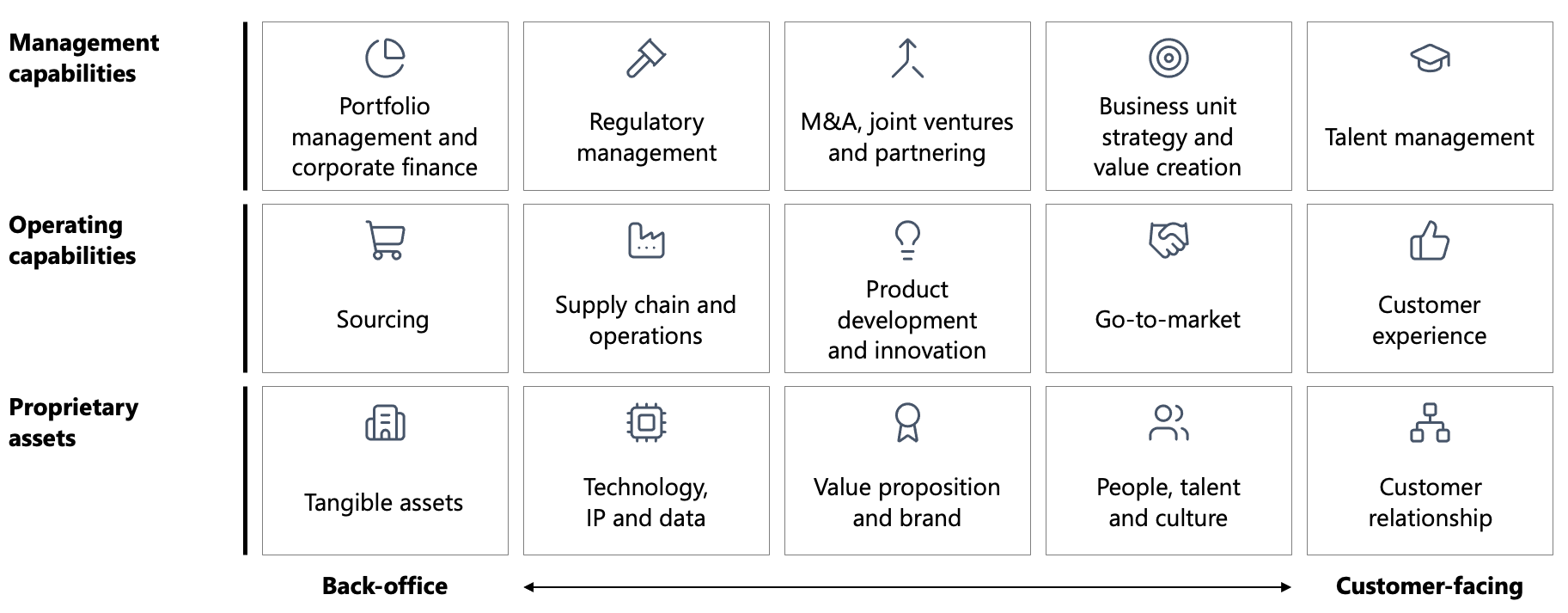
The list is generic, so it can only be a starting point. Take each candidate and ask "how do we do this, uniquely?" until the answer is specific to you. That usually takes a few rounds. For our Zara example, it could go like this: Why do customers choose us? Because the store looks different every week. What do we need to be able to do for that? On the list, the closest is supply chain and operations. How do we do this, uniquely? We are fast. How, uniquely? We bring a new design into our stores within a few weeks, while others plan a season ahead. That is specific enough to be a must-have capability. Ask once more and you get to designers sitting next to production planners and to deliveries twice a week. Those are operating system choices, and we will look at them below. One way to tell them apart: a must-have capability says what you need to be able to do. An operating system choice says how you set up your company to do it.
I propose you aim for three to five must-have capabilities that are:
- Viable: you have them, or you can build them. If not, change your where to play and how to win.
- Decisive: your best competitor cannot or will not match them as a whole set, and you are willing to invest more in them than others do.
- Mutually reinforcing: each one makes the others stronger (or at least does not fight them, more on that below).
If you cannot name your must-have capabilities, your where to play and how to win are probably still too vague. If your list grows beyond five, chances are that it contains things your competitors do just as well.
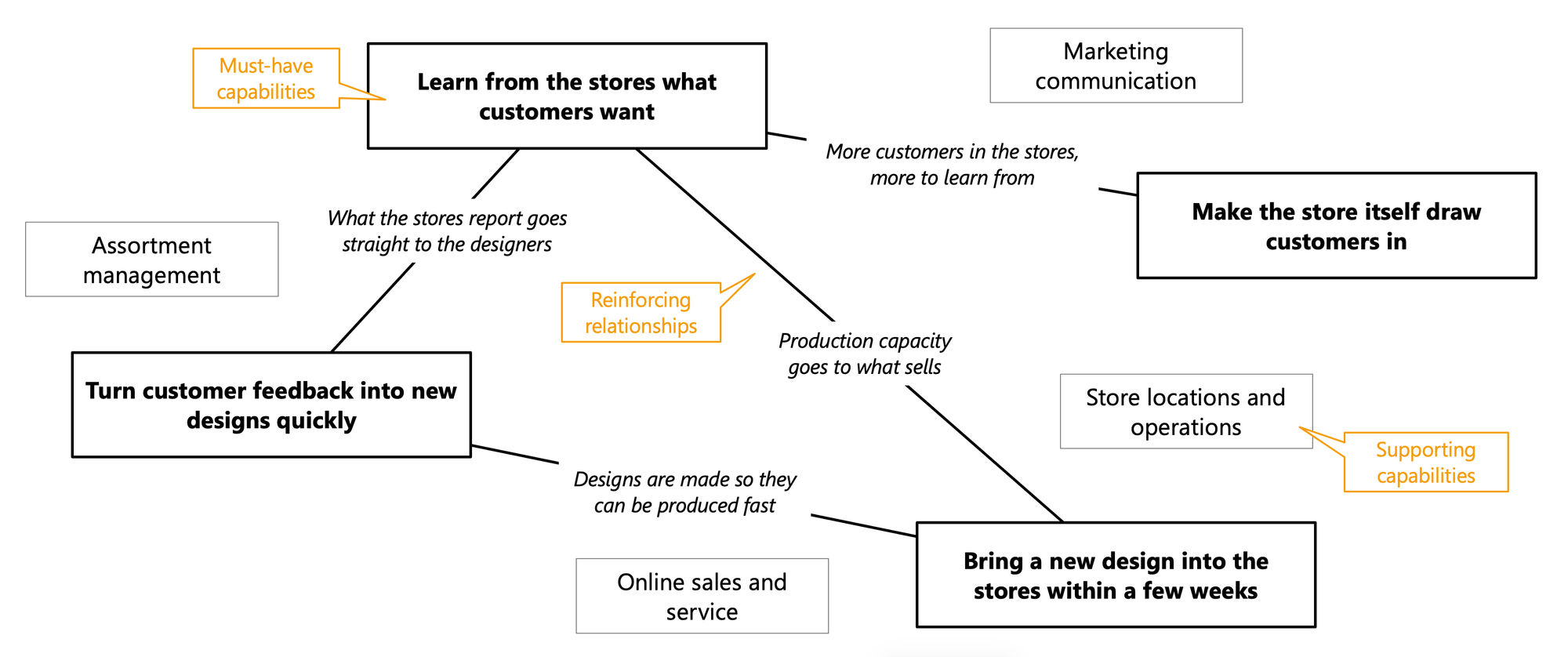
So far, we looked at one of Zara's must-have capabilities. Below you see its capability map with the full set: four must-have capabilities, lines that show which reinforce which, and a few supporting capabilities around them.
How we do things around here
Operating system choices are what make a must-have capability real. A must-have capability is not a single thing you implement: a program, a project, a new role. You have to build it into "how we do things around here", and that is what your operating system defines.
Take customer focus. We saw above that it is too broad to be a must-have capability. But look at how much even this generic term affects once you take it seriously. If your development team sits four layers away from the customer, you are probably not as customer-focused as you want to be. The same goes if a measure like the Net Promoter Score is not among the first KPIs you look at. Where do customers come into your processes, and how quickly does their feedback reach the people who can act on it? Is after-sales service taken seriously and funded well, or treated as a pure cost center and a career dead end? Do your interviews and performance reviews check whether someone cares about customers? This goes across the whole operating system, affecting all aspects of "how we do things around here".
So for each must-have capability, think through how the six elements of your operating system need to be set up. Below you see how Zara set them up to bring a new design into its stores within a few weeks.
- People. About 200 designers of its own, hired for enthusiasm and talent. No prima donnas.
- Strategy. Invested in its own factories for the more complicated products (about half of the total).
- Priorities. Speed came before cost per piece. No KPIs that made an individual step efficient on its own at the cost of slowing down the whole.
- Structure. Designers sat next to market specialists and production planners. Together they chose a design and committed to it within hours.
- Processes & initiatives. Stores ordered twice a week and received deliveries twice a week, on a fixed schedule.
- Information technology. Handheld computers in stores sent orders, sales trends and customer reactions to headquarters. Bar codes tracked every piece.
Zara facts: Ferdows, Lewis and Machuca, "Rapid-fire fulfillment" (Harvard Business Review, 2004)
As you can see, creating a new role, running a training program or adding a process may each be necessary. None of them is sufficient on its own to build a must-have capability.
Several must-have capabilities, one operating system
You need several must-have capabilities, but you have only one operating system. So the operating system choices of all your must-have capabilities have to fit together, into one coherent operating system.
It is possible to have must-have capabilities that each sound good on their own, but need conflicting things from the same operating system elements. Two examples:
- Innovation against reliability. Being the first to bring new technology to market needs freedom and tolerance for failure. Delivering reliably at volume needs process discipline, change control and quality assurance. The two collide in who you hire and in priorities: does time to market matter most, or failure rates in the field?
- Customization for large customers against one product platform. This is the situation from the opening of the last post. The two collide in priorities and structure: do you put your R&D resources behind the customized version for one customer, or behind the next generation of your products? Is your go-to-market team set up to serve a few large customers with tailored offerings or to sell standardized, configurable products to a broader market?
If two must-have capabilities fight, go back to your where to play and how to win. They should tell you which must-have capability is more important. Or you realize that you avoided a difficult choice when you made them ("we are the most innovative and the most reliable"). That choice now comes back as a fight in your operating system.
Local optimization makes these conflicts worse. People optimize the parts in their direct control, and often that is what they are measured and paid for. But it can undermine the bigger picture. Zara decided against local optimization. It sent half-empty trucks across Europe and paid for airfreight twice a week to ship coats on hangers to Japan. Few teams would decide to organize their processes that inefficiently. Zara did, because speed came before cost per piece.
All of this sounds quite tricky, and it is. The members of the leadership team have to settle these conflicts together, and accept that some choices will be suboptimal for their own part of the company. But if you manage to do it, you create something that is hard to copy: a whole operating system that pulls in the same direction. The moment a competitor adopts some pieces of it, these pieces start to fight the rest of its existing setup. And copying the whole thing at once is something few companies can do while keeping their business running.
Toyota is a good example. General Motors formed a joint venture with Toyota, called NUMMI, to use Toyota's production techniques. Toyota offered full transparency. Despite that, and many millions invested, General Motors could not replicate the results in its own plants.
From blueprint to building
Begin by writing down your must-have capabilities, based on your where to play and how to win. The steps from above help: start from the reason customers choose you, and ask "how do we do this, uniquely?" until the answer is specific to you.
Then translate each must-have capability into operating system choices: what does it need from each of the six elements? Put the answers side by side and check the fit. In each operating system element, do your must-have capabilities pull in the same direction, or do they require you to implement conflicting things?
Where they conflict, first go back to your where to play and how to win. Then look for another way to set up your operating system choices, and iterate. Some conflicts may stay. In that case, you at least need to be aware of them and find a workable compromise. What you get in the end is a blueprint for an operating system that fits your strategy.
Next, you need to build what is missing. I propose you start with your weakest must-have capability: the one you are least sure you can deliver today. Improving what already works does not help much as long as something crucial is not yet set up well.
Building a must-have capability is about change, and change is steered through goals. Do not start fifty things in parallel. Within the must-have capability you want to work on, pick the gap that hurts most, make it one of your goals and start tracking it.
The template below lets you write all of this down: a capability map, and a table with the six operating system elements and one column per must-have capability. It is set up for three must-have capabilities. If you have more or fewer, adjust it. The second and fourth slides show the pages of Vektor, a fictional company making force-torque sensors for industrial robots, including two conflicts it has to live with.
What comes next
Your where to play and how to win only become real through what your organization is able to do. Your must-have capabilities say what that is, and your operating system choices make it part of "how we do things around here". If they fit together, you get an operating system that pulls in the same direction and is hard to copy. In other words: sustainable competitive advantage.
With this, we have covered all five strategy choices. In the next post, we will look at how to work through them end to end and lock in choices.
Further reading
- Playing to win by A. G. Lafley and Roger Martin: My favorite book on strategy. Chapters 5 and 6 cover must-have capabilities and management systems, including P&G's capability map.
- What is strategy? by Michael Porter: One of the most influential articles on strategy, and a short read. It is full of activity systems and shows why advantage comes from how a company's activities fit together.
- Strategy that works by Paul Leinwand and Cesare Mainardi: A practical book on how to describe and build capabilities, with many company examples (Zara is one of them).
- 7 powers by Hamilton Helmer: A great book on sustainable competitive advantage (power). The chapter on process power tells the story of Toyota and NUMMI.
I value feedback. If you see something worth challenging or improving, feel free to reach out on LinkedIn. I treat these posts as living documents and will update them over time.