
7 | Earned autonomy: the social contract at the heart of systems that scale

In previous posts, we looked at the operating system elements that can get you out of the reactive firefighting often found in growing organizations: operating rhythm, goals, and KPIs. This article is different. It is not about mechanics. It is about what I consider the shared foundation of the systems that scale best: earned autonomy.
Think of people you have worked with who just reliably deliver. They commit to outcomes and meet them. If an unforeseen issue comes up, they flag it early and honestly, before it becomes a crisis. They do not just surface problems, they also propose credible mitigations. Over time, something happens around these people: they get more freedom. Even controlling managers and perfectionistic colleagues eventually stop checking on the people whose work they never have to chase.
This dynamic is largely created by these people themselves. Yes, circumstances matter. But the pattern comes through in all kinds of environments, from supportive to dysfunctional. These people have something in common: they take ownership for what they can influence, and they follow through. This earns them trust, and that trust becomes freedom. I call this pattern "earned autonomy".
I have come to believe that this is the best pattern to scale organizations with. Jim Collins articulated a version of it ("freedom and responsibility") in "good to great". Reed Hastings popularized the concept at Netflix, but his version comes with a condition I disagree with: that it only works with exceptional people. Two counterexamples: David Marquet took the USS Santa Fe, the US Navy's worst-performing submarine, and within a year made it the best. Not by replacing the crew, but by giving them clarity on purpose and goals, building their competence to make sound decisions, and relinquishing control to let them decide how to get there. Ed Catmull made the same change happen at Walt Disney Animation after the Pixar acquisition: a studio that struggled for years went on to reliably make world-class animated films with "the same people who were there when they were failing" (Ed Catmull's words). What changed were the systems, and with them how people worked together.
Clearly, having high talent density helps – Jim Collins also argued for having the right people on the bus. But given the right environment, many more than just the very best can rise to the challenge of earning autonomy.
Maximizing, not balancing, accountability and autonomy
To build earned autonomy, it is important to see that there is no trade-off between accountability and autonomy. Many people instinctively manage as if there were only one dial: tighten control, or extend more trust. That instinct treats accountability and autonomy as a trade-off: more of one, less of the other. That is the wrong frame. They are two separate axes, and the best results come from environments that maximize both.
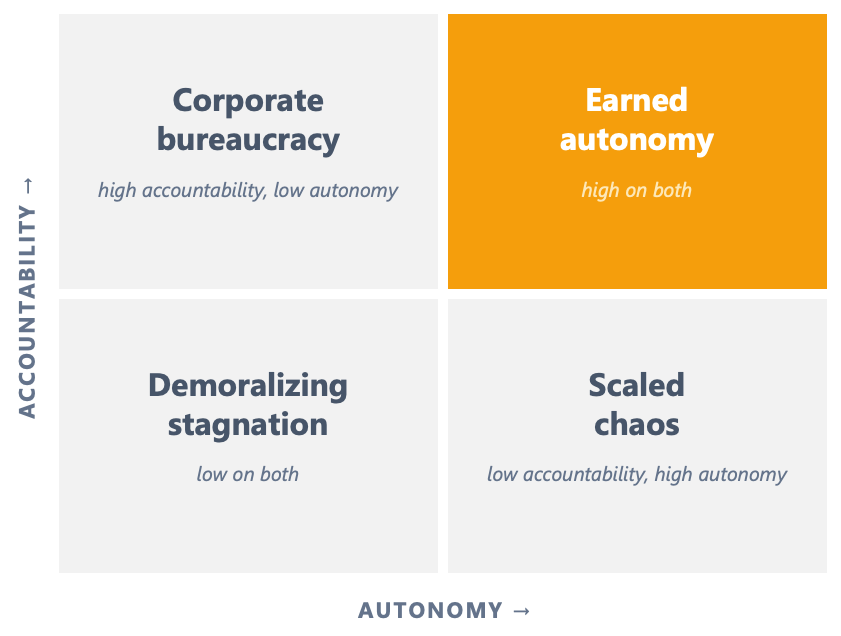
Mapping the two dimensions creates a simple 2x2 with three other states next to earned autonomy. I am sure several of them will trigger vivid memories for many (they clearly do that for me).
The worst place to be is where neither accountability nor autonomy exist: demoralizing stagnation. Nobody is trusted, nobody delivers, nothing moves. What makes this state particularly dangerous is that no organization chooses it deliberately. It is where the coordination headwind pushes you if left unchecked: as the company grows, focus blurs and alignment fades. Without clear priorities, there is nothing to be accountable for. As ownership erodes, leadership teams feel compelled to step in and override decisions, killing autonomy in the process. Both dimensions collapse together. Many high-growth companies are probably closer to this state than they realize.
High accountability with low autonomy is what I call corporate bureaucracy: things get done, but in a constraining environment, amid politics and fear of showing red measures, with many decisions taken at the top. It can work, which is why it remains popular. But it struggles with talent retention and innovation, and it is brittle: as the company scales, complexity grows faster than the center can absorb it. When the center cannot keep up, it drags the whole organization down with it.
Scaled chaos (high autonomy with low accountability) can feel liberating initially. Many leaders of growing organizations move in this direction because they believe it preserves the energy they felt when the team was small, with everyone trusted to do the right thing. But over time, with more people and no additional structure, teams lose track of what truly matters and start moving in different directions, pulling the organization apart. It also creates places to hide for people who are not delivering. The rest of the team will notice, and that in turn erodes morale and puts your best people at risk of leaving.
Earned autonomy is lived in places where you (and everyone else) are fully expected to deliver results, and given significant freedom to do so. It unlocks intrinsic motivation – people feel treated like adults, playing to win as a team. It is also the only configuration that scales gracefully: unlike corporate bureaucracy, it does not depend on a high-throughput center. Unlike scaled chaos, it does not pull itself apart with growth.
Many companies actually start in earned autonomy: when the team is small, everyone has enough context, nobody has time to micro-manage, and team members who do not deliver stick out. These companies then drift out of it as growth overwhelms informal coordination, pushing them first into scaled chaos, and then sometimes, as a counter-measure, into corporate bureaucracy.
Earned autonomy is fractal
One characteristic that makes earned autonomy scale well is that it is fractal: from the personal to the company level, the inner setup of a unit is what drives its accountability, and that accountability earns it autonomy from the outside world.
One framing matters before we walk through the individual levels: "outside" does not mean "higher up." The contract runs in every direction, vertically and horizontally, and is always mutual. A team and its manager owe each other delivery on what they promised. Peers earn trust and autonomy from each other by holding up their commitments. Larger units do the same across the organization.
At the personal level, accountability comes from internal discipline and follow-through. This is what Stephen Covey calls the private victory: be proactive, begin with the end in mind, put first things first. David Allen's "getting things done" is a practical implementation for this: a personal productivity system that makes follow-through sustainable.
At the team level, accountability has two elements: individual performance and the team's collective result. Personal delivery is necessary: if you do not deliver your share, you cannot remain part of the team. But it is not sufficient. Even when you excel individually, the team result is what matters most. Local optimization cannot come at the cost of the whole. A striker who is satisfied with scoring two goals after the team lost 2:3 is hiding behind "I did my part". One such player can be enough to break the contract for everyone.
At the inter-team level, Henrik Kniberg's "loosely coupled, tightly aligned" is a good foundation: teams that operate independently while pulling in the same direction. But I think accountability goes beyond that. Next to understanding other teams' goals, it is also about doing what we said we will do for each other. A team that regularly misses its commitments to other teams will struggle to retain its autonomy: others will start to micromanage or bypass it.
At the company level, we are back in the 2x2. The whole organization either earns or forfeits its autonomy from the world it operates in – customers, employees, investors, regulators. The mechanism is the same as at every other level: inner discipline, demonstrated via follow-through and good faith, earns autonomy on the outside.
Making the contract real
For earned autonomy to work, it needs to be treated as a social contract: everybody holds up their part of the bargain and delivers on their promises, which in turn makes work easier, faster, and more enjoyable for everyone. But that contract needs three things to become real: clarity, a pull, and a push.
Firstly, clarity: a contract only works if everyone knows what they signed up for. If it is not clear what someone was supposed to deliver, holding them accountable becomes arbitrary. And if people do not know where the company is heading and what matters most, you cannot give them much freedom either, because their decisions will pull in different directions. Clarity on direction, priorities, and ownership is not enough on its own. But without it, neither accountability nor autonomy works. Creating it is first of all a leadership job. But if things are unclear to you, do not wait for someone to fix it. Ask.
Secondly, the pull: stop waiting for others to move first. Waiting is the most common way the contract breaks. The team waiting for the manager to extend trust. The manager waiting for the team to demonstrate they deserve it. Peers waiting for each other to deliver before they will. It is sad how many times I have seen some form of this playing out over the years. The way to break through this is to stop waiting and start holding up your end, even if it feels like you do more than your fair share initially. You probably are, but that is what breaks the stalemate.
This is not specific to the workplace. The same dynamic plays out between friends, within families, in any context. The colleague who happens to also be your manager is just one more person you are in this contract with. This is not about power dynamics. It is about taking initiative.
Thirdly, the push: the contract needs enforcement. If people who do not hold up their end face no consequences, the contract is not real. People will start wondering: why deliver, why care, why follow through, when others get away without?
The contract holds for everyone. Nobody is exempt: one can neither be too senior or too indispensable (CEO, founder, most tenured employee, technical genius) nor too junior (new joiner, junior contributor). Once exemptions appear, the contract erodes.
When someone persistently does not hold up their end, despite honest feedback and a fair chance to improve, they need to leave. Not as punishment, but for the sake of everyone else who is respecting the contract. This is the part of earned autonomy that is hardest to live up to. These conversations are uncomfortable. These decisions feel personal. But avoiding or delaying them protects the person who broke the contract at the cost of everyone else. And the damage compounds the longer the decision is dragged out.
"Mercy to the guilty is cruelty to the innocent" – Adam Smith
Making the contract real is not easy, but I am convinced it is worth it. Not just for the company, but for every individual. Ultimately, this is about agency. The agency to set your own direction, to choose your own path, to be in charge of your own destiny. At every level, in every role.
The OS as a trust-building engine
As said, every individual is responsible for holding up their end of the contract. But the environment around them matters too: it can make this much easier, or much harder. As discussed in the first post, the company's operating system is what shapes this environment: it is the set of elements that determine how an organization gets work done. Not just the mechanics (like goals, processes, and org structure), but also the people, values, behaviors, and incentives.
While the elements of an OS are universal, their configuration is not. Depending on the configuration, a strong OS can support and reinforce one of two possible states in the 2x2: corporate bureaucracy and earned autonomy. At the surface, they can even look similar, but they feel very different to operate in. The best way to describe it I found so far is "closed vs. open": an OS built to protect, or one built to enable.
In corporate bureaucracy, the way the OS runs feels closed. Information flows upward and only on a need-to-know basis. Decisions happen in small circles and are communicated downward. Status reports are about managing perception: off-target goals and measures get explained away until they cannot be hidden anymore. The implicit goal is to make sure you cannot be blamed for failures (with not actually failing only as a second priority). The OS's purpose is to increase control.
In earned autonomy, the way the OS runs feels open. Information flows broadly so that shared context can produce better decisions. Decisions happen with the people closest to the work. Status reports are about surfacing reality: off-track goals and measures get flagged early because the system rewards flagging them. The implicit goal is to make things work and get better together. The OS's purpose is to increase trust.
An OS configured for earned autonomy also does something else: it makes trust scale. Personal trust is hard-capped: you cannot have a real working relationship with everyone in a 200-person company, let alone in a 2000-person one. But companies do not actually need personal trust between everyone. They need systemic trust: the ability to assume that a person you have never met, in a team you have never worked with, will deliver what they said they will. The OS can create that systemic trust so that you can operate effectively with people you have never met.
"A Bainie never lets another Bainie fail" – Bain & Company operating principle
Without an operating system that is configured for it, earned autonomy stays a slogan. A value statement on a wall. With it, trust – and therefore autonomy – becomes something you can actually build and maintain at scale.
What comes next
I will keep returning to earned autonomy across future posts as it significantly impacts the configuration of all operating system elements. In the next post, we will look at values and behaviors, as they are most tightly linked to earned autonomy.
Further reading
- Good to great by Jim Collins: A great read on what separates the best companies from the rest. His chapter on "the culture of discipline" is highly relevant to earned autonomy.
- Turn the ship around by David Marquet: My favorite demonstration that earned autonomy works with normal people, not just excellent ones.
- The 7 habits of highly effective people by Stephen Covey: The three "private victory" habits (be proactive, begin with the end in mind, put first things first) build an excellent foundation for earned autonomy at an individual level.
- Getting things done by David Allen: A practical personal productivity system that enables the follow-through needed for earned autonomy.
I value feedback. If you see something worth challenging or improving, feel free to reach out on LinkedIn. I treat these posts as living documents and will update them over time.