
8 | Values & behaviors: deciding what your organization stands for

Who this post is for: Leaders whose organization has grown beyond where culture takes care of itself, and who now need to become explicit about the behaviors they want to see lived.
TL;DR:
- Lived behaviors, not stated values, shape culture
- Most organizations build their behaviors from similar values (customer focus, integrity, ownership, excellence, teamwork, speed, innovation, candor, ambition) plus a few specific to their strategy
- Pick your values by what matters most, not by what makes you different
- To build your own set, diagnose what you live today, pick the values that matter most, then sharpen them into 5 - 7 concrete behaviors
- The harder part is living them, which will be the topic of the next post
Does your company have values written on walls that you and your coworkers have quietly stopped believing in? Or are there behaviors you care about that you can feel slipping as the company grows?
Maybe one of them is "accountability" or "we hold each other to high standards". But then in a review, a target comes up that was clearly missed, and nobody says anything. Perhaps somebody tentatively asks what happened, and only gets a short, vague response. And then the meeting simply moves on. Everyone in that room has just learned the real rule, the one that overrides anything written on walls or quietly expected by leaders: accountability and high standards are not that important around here.
Defining and communicating your values matters. But how you act matters far more. A value is only a belief; what others see, and what shapes the culture, is the behavior it turns into. When what an organization says and what it does diverge, it is always the doing that shapes the culture.
"What you do is who you are" – Ben Horowitz
These lived behaviors are very important, because they shape what people decide and do when no one is directing them. And no one is directing them most of the time, especially when you aim for decentralized decision-making and earned autonomy.
When an organization is small, this takes care of itself: the desired behaviors are constantly modeled and seen by everyone, and deviations are hard to hide. But as you grow, the people who shaped the culture early on can no longer be in every room. Most people now learn "how things are done around here" secondhand: from their peers, their manager, what gets tolerated in their own meetings. This is the point where what used to happen on its own has to be done on purpose: you have to become explicit about the behaviors you want to see lived. That is what we will cover in this post.
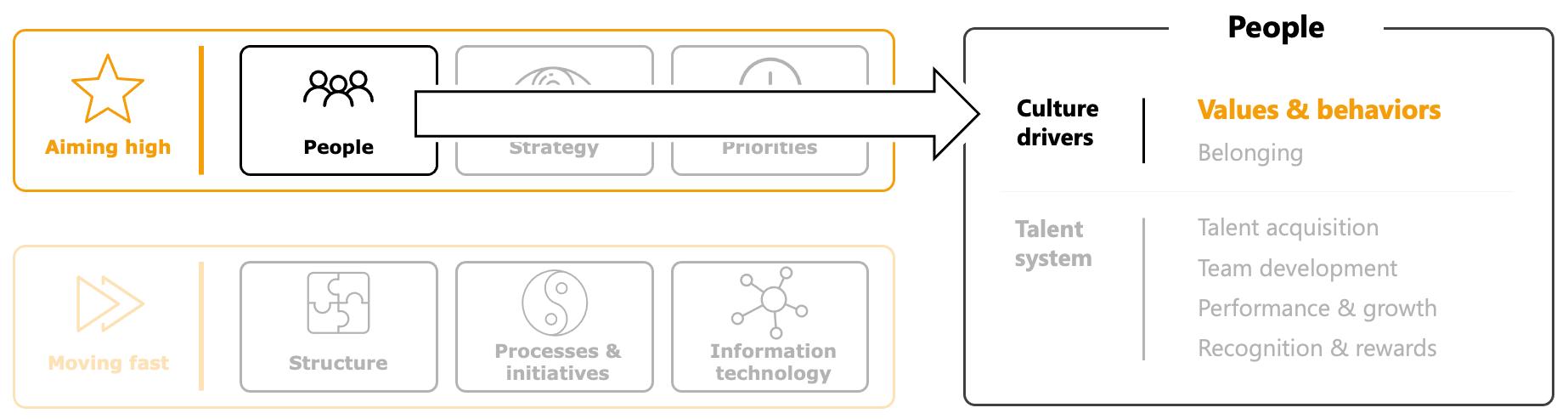
What drives culture
A value is what you believe matters. A behavior is what that value looks like in action: observable, specific, something a person actually does. The distinction may sound like a detail, but it is crucial: behaviors, not beliefs, shape culture. Only a behavior can be seen, taught, hired for, and held to account. I like writing them as a pair, value then behavior: "Integrity" cannot be acted on; "integrity: we never mislead, even when the truth costs us" can.
Browse through a few dozen company websites and it becomes clear that a handful of values are very common (interestingly, it barely depends on geography or industry): Customer focus. Integrity. Ownership. Excellence. Teamwork. Speed. Innovation. Candor. Ambition. Form and wording vary, but the underlying values do not.
You could now say this is generic and therefore meaningless. But I think you would be wrong. These values recur because a lot of smart, experienced people kept reaching the same conclusion: these are the things a company needs to function well. The easiest way to see this is to try the opposite. Build a company that does not put the customer first, treats ownership as optional, or works without integrity. You will not get a more distinctive company, just a worse one. Unlike strategy, culture is not (primarily) about being different: strategy demands differentiation, values do not. That others aim for the same things is no reason for you not to.
This does not mean that every company should just aim for the same culture. You choose which of the "common values" to emphasize (all of them at once will overwhelm your teams). You decide whether to add values that are more unique to you (often derived from your strategy: e.g. frugality for a cost leader, or craftsmanship for a design-focused organization). And you sharpen each value into a concrete behavior that fits your organization.
Working through that is what the rest of this post is for. Actually living the behaviors day to day is harder still, and that we will look at in the next post.
Diagnose where you are
Values are easier to name, but behaviors are what you can actually observe. So you need to make a round trip: start by reading the behaviors people show today to surface the values that are already lived. Then add the values you will need going forward and commit to a set. Finish by making each value concrete again by writing the behavior that expresses it.
Start by looking at the culture you already have. The point is to keep what already works, so you build on it rather than replace it. The most direct way to see it is to ask the people who live in it, via a short survey (keep it anonymous to get more honest answers):
Behaviors we live today
- What behaviors do we reward?
- What behaviors do our best peers show?
- What behaviors do our best leaders show?
Behaviors we want to live in future
- What behaviors should we keep and amplify?
- What behaviors should we stop or fix?
- What behaviors should we start?
Use free text rather than multiple choice, because you want people's own words. Run two separate surveys: one across the organization, and one for leadership as its own group. Two views are more useful than one: where they agree, you have a strong signal; where they diverge, you have found a place where leadership and the rest see things differently. That is worth knowing before you decide anything.
You will end up with a lot of raw text. Cluster individual answers into themes, per question and per group (AIs are great at that). Most of these behavioral themes will map onto the common values from above, but a few will be specific to your company.
If you already have written-down values or behaviors, compare them to the clustered answers to the first three questions (behaviors we live today). Check for things you have stated but did not come up in the responses. These are the gaps between what you say and what you do.
Finally, consolidate it into a single view: the themes, how often each came up, and where the organization and its leaders agree or differ. That consolidated picture is what you take into the next step.
Sharpen where you want to get to
After gathering a picture of where you stand, you can start defining where you want to get to. The goal is a short set of concrete behaviors your organization will actually run on. You get there in two steps: first select the few values that matter most, then translate each into a concrete behavior. The values decide what you stand for; the behaviors make it concrete and observable. This is leadership's job, not a vote: the choices involved are judgement calls leaders need to own and enforce. And it is best done across a couple of working sessions.
Select the values. In the first session, with the consolidated view in front of you, pick the few values you will commit to (five, maybe seven, not fifteen). This is harder than it sounds, because you are choosing among only good things.
Values that landed near the top for both the organization and its leaders are your strongest candidates, but do not just count votes: what gets named most is what is most visible today, while a value you will truly need mid-term may have been named by only a few. Some of those may even be values your leadership team does not yet model well. Those are the hardest to commit to, because living up to them will mean changing yourselves, too.
One value deserves special mention: ethics. Integrity is the one value that tends to work against your other goals. It usually costs you deals rather than wins them, at least in the short term. That makes it the easiest to quietly leave off the list, and that is exactly why it needs to be on it. You need to be explicit about what is non-negotiable.
Distill the raw material. Between sessions, take the selected values and check back on the actual behaviors brought up in the survey. Boil them down to a handful of candidate behaviors (sometimes combining several responses, sometimes drafting a sharper one than anyone submitted).
Write the behaviors. In a second session, turn each value into a specific, observable behavior, concrete enough to act on ("integrity: we never mislead, even when the truth costs us"). Work from the candidates, refine them together, and where you are torn between two phrasings, vote. What comes out is the first full draft of your behavior set.
Clean up and get feedback. After the session, tidy up the draft, then share it first with the group that drafted it, then with the whole organization. Refine again from what comes back.
Let it evolve. This is a living set, not a law written in stone. You do not need to redo it every year, but you will revise it as you learn and as your strategy evolves. If you already run an "annual outlook" similar to what we discussed in the operating rhythm post, this is a good place to revisit this list. The goal is not to get this permanently right (that is impossible). It is to get it right enough to start living it, which is the part that actually matters.
Common pitfalls
I want to highlight a few issues that may come up. Here are the four I think are most likely:
Choosing values leaders will not live. It is tempting to pick values you wish were true rather than the ones you and other leaders will actually model. But trying to make an organization live up to values its leaders cannot commit to modeling is a lost cause: it only widens the gap between stated and lived, rather than closing it.
Too many behaviors. This is the hardest to resist: the values on the table are all genuinely good, and cutting feels like losing something. But a list of twelve is a list nobody can remember. And what people cannot remember, they cannot live. (Amazon is the exception with its sixteen (!) leadership principles, but only because it commits significant effort to drilling them in.) Be disciplined, keep the few that matter most, and accept that you are leaving good things out.
Staying too vague. You may feel tempted to stop at the value ("customer obsession") instead of writing the behavior you can be held accountable for ("customer obsession: what is better for the customer over what is easier for us"). Keep pushing until it is specific enough that you could tell whether someone followed it.
Borrowing someone else's list. Perhaps you consider taking the behaviors of a company you admire and adopt them wholesale. But that list specifically fits their culture and strategy, not yours. Copying it means skipping the diagnosis and never uncovering and building on what already works in your own organization. Use others for inspiration, but the set you commit to has to be yours.
Looking ahead
Do not worry about not getting this perfect on the first pass. Just get going and aim for a good-enough first version you can begin working with. You now have your starting point: a short, concrete set of behaviors, chosen to fit with where your organization is going. But having desired behaviors on a page changes nothing by itself. The hard part is using them to shape how people actually act when no one is directing them. That will be the subject of the next post.
Further reading
- What you do is who you are by Ben Horowitz: The book I drew on most here; its insistence on concrete behaviors over lofty values is its strongest part.
While I have read other books on culture, this is the only one I am willing to recommend so far. If you know other genuinely good ones, please share, I am happy to learn more.
I value feedback. If you see something worth challenging or improving, feel free to reach out on LinkedIn. I treat these posts as living documents and will update them over time.