Effective goals: setting priorities that create focus and drive change

I am regularly surprised by how few people have clear goals for themselves or their team. When you ask, most say, "yes, of course we have goals." But if you dig deeper, things quickly become vague.
Effective goals are one of the fastest ways to get an individual, a team, or even an entire company out of chaos and restore direction. This is why I want to write about goals first, before touching on other operating system elements.
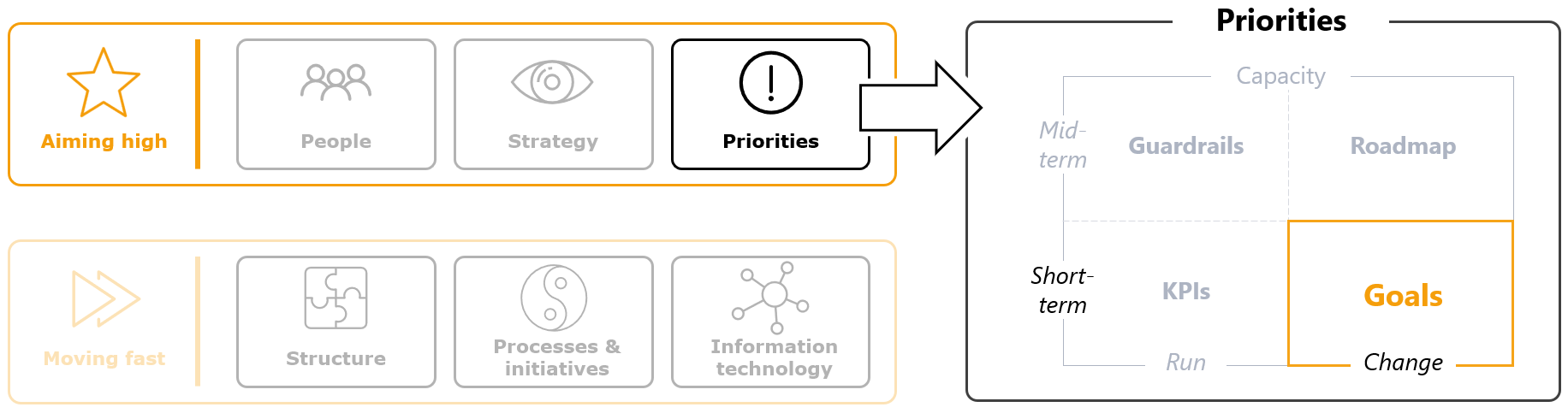
Before going into what makes goals effective, let me share where goals sit within the operating system framework I use to structure my writing. Goals are one of four parts within "Priorities". I use the word "goals" for short-term priorities (a few months to a year) that focus on what you want to change (as opposed to what you want to keep running). I will cover the other three parts within "Priorities" in future posts.
Why start with goals
Goals are a great place to start when your organization faces a strengthening coordination headwind – when things become slower, focus and alignment decline, and you are pushed into reactive survival mode. One big advantage of goals is that you can set them relatively quickly. Even if your leadership team disagrees on strategy, values, or org structure, you can usually still agree on a small number of no-regret goals that people can act on right away – without a week-long offsite to resolve all differences.
Starting with goals may go against many leadership teams' instincts, which often push them toward strategy debates. The risk is that you spend weeks discussing strategy without giving teams anything that helps them move forward now. Therefore, if goal setting is not yet a strength of your organization, I propose you start there. Once you have regained momentum, you can still refine direction – strategy discussions matter, but they should not delay setting no-regret goals.
What makes goals effective
"It almost doesn't matter what you know; what matters is what you do." – Andy Grove
I love this quote. It conveys a fundamental truth in a very simple way. Many organizations have plenty of smart people who know a lot about many things. But the problem is not knowing, it is doing. Great goals help you bridge that gap. They turn knowledge and discussions into action and results.
Effective goals share a few common traits:
- They drive value. They connect to how you create value for a customer (internal or external). Great goals start from the question "who is better off when we succeed?"
- They create focus. Fewer goals are better. Clear choices force trade-offs. Because if everything matters, nothing does.
- They are clear and concrete. Anyone should understand your goals without extra context. Avoid vagueness and buzzwords. Simpler is always better.
- They are measured by outcomes. Describe the intended change (outcomes), not the activities you plan to do. "80% of customers use the new self-service feature" is significantly better than "launch the new self-service feature".
- They are ambitious but realistic. Aiming slightly beyond what seems possible is motivating. Go too far and it becomes demoralizing.
What structure to use
To make these principles practical, you need a structure for writing goals. Several exist, but my (and many others') favorite is Objectives and Key Results (OKRs). As Andy Grove ("the father of OKRs" according to John Doerr, a contender to that title himself) wrote, OKRs separate two key questions:
- Where do I want to go? -> the Objective
- How will I see if I am getting there? -> the Key Results
One great thing about OKRs is that they are very flexible – but there are a few guardrails you may want to keep in mind:
- Pick a useful time frame. I propose you define Objectives that span 6 - 12 months to provide a stable "north star", then set Key Results for a quarter. Shorter cycles do not allow for real change, much longer cycles weaken accountability.
- Keep the number of Objectives low. One to three is a good range. Create too many and you lose focus.
- Limit Key Results per Objective. Three to five is a sensible range. Enough to define success, not so many that they become overwhelming.
- Do not try to capture everything. OKRs are not meant to be a list of everything you do. They highlight what matters most and force you to leave out the rest.
- Keep OKRs at the team level. This may be controversial (John Doerr and Google may disagree), but I find OKRs more effective at the team level than at the individual level. Team OKRs are great for alignment and collaboration.
I am a fan of a customer-centric OKRs as described by Jeff Gothelf and Josh Seiden in their excellent book "who does what by how much". There is a lot to say about how to write strong OKRs, but simply using Jeff's and Josh's structure will already create good Key Results:
Who (customer) does what (behavior) by how much (measurable change)
If your Key Results look like that, chances are high that you have written solid goals.
An example and a template
Here is a simple example of how a high-quality OKR looks in practice (adapted from "who does what by how much" – see further reading):
- Objective: Provide the best customer experience in the industry within two years
- Key Result 1 (committed): By March 31, 100% of new enterprise customers are fully onboarded and active within 30 days of signing
- Key Result 2 (committed): By year-end, existing customers make referrals at a 25% higher rate than last year
- Key Result 3 (stretch): From Q2 onward, customers who experience serious issues that require support become boosters, renewing their contracts at a 100% rate
To make OKRs practical across a whole organization, I recommend using a simple, standardized template in a widely used tool. I propose reusing a tool you already have instead of introducing a new one just for goals. Something as simple as PowerPoint can work well. One slide then becomes your (and other) team's "unit of communication" for goals.
Using a standardized format has two main advantages:
- Focus by design: It visually limits you to a few Objectives and Key Results, preventing the "do everything at once" trap.
- Transparency: When every team uses the same format, it is much easier for people to understand each other's priorities without needing a long explanation.
Common traps in goal setting
There are a few common issues you should try to avoid:
- Do not set too many goals. Trying to do everything at once destroys focus and slows progress. Stop starting, start finishing.
- Do not describe activities. People often list tasks ("launch X") instead of the intended change ("80% adoption"). Activities feel productive (and safer to commit to), but they do not show whether you are actually winning.
- Do not use vague language. Be wary of words like "optimized", "enhanced", or "improved". Always combine them with a clear measure. Without one, you cannot judge success.
- Do not change goals mid-cycle just because progress has stalled. Adjusting goals when reality changes is healthy. Quietly lowering them because you are behind is not. A quarterly cycle is short – you will learn more from a "fail" and an honest review than from moving the goalposts mid-way.
- Do not include work that is not real change. OKRs are for the few things you want to change, not for business-as-usual work. Only include meaningful shifts or improvements and leave out activities you do to "keep the lights on."
How to embed goal setting
So far, we have outlined how to set effective goals. But writing good goals is only the first step. Linking them tightly to day-to-day work is the more important part.
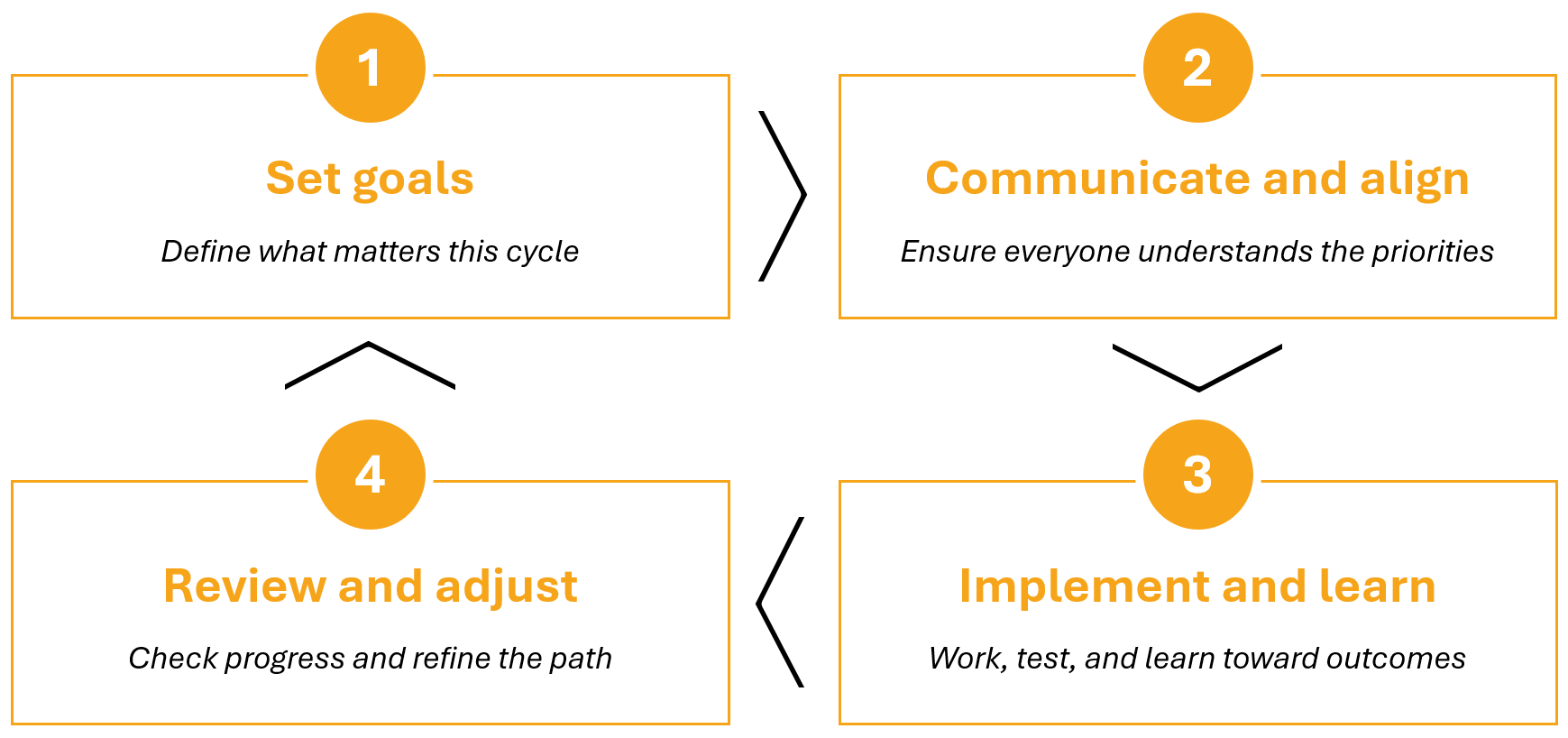
For that, you need a simple, repeatable rhythm that keeps goals visible, drives implementation, and creates accountability. I propose you start with something like this:
1 | Set goals
Effort: a few hours at the start of the cycle
Define a small number of goals for the next cycle (as mentioned, a quarter works well for Key Results, consider keeping the Objectives stable for 6 - 12 months). Distinguish between committed goals (100% achievement expected) and stretch goals (ambitious targets where 70% achievement is a win). Start with the company goals, then help teams translate them into team-level goals. Ensure every goal has a clear owner so that nothing falls through the cracks, but give teams room to propose their own goals to capture local opportunities.
2 | Communicate and align
Effort: several short intervals within the week after goal setting
Share the goals widely. Talk about them at all-hands meetings, bring them into team check-ins, and publish them where people check regularly (e.g. on your intranet). Make sure everybody understands what the goals mean, why they matter, and how they connect to the company's direction.
3 | Implement and learn
Effort: most of the cycle
Work toward the goals. Use them to guide what you start, stop, and prioritize. As you make progress, test assumptions, look at data, and learn what actually brings you closer to the intended outcomes.
4 | Review and adjust
Effort: a few hours spread across the cycle
Hold regular check-ins (weekly or bi-weekly) and a more structured mid-cycle review. Look at progress, blockers, and learnings. Focus on the topics that are not on track and discuss how to recover or if circumstances require an adjustment. At the end of the cycle, grade each Key Result using one of these scales:
- The 0.0 - 1.0 scale: Select a score in 0.1 increments based on the data. For committed goals, only 1.0 is green (0.0 - 0.9 is red); for stretch goals, 0.7 - 1.0 is green (0.0 - 0.6 is red)
- The traffic light scale: Use only green and red dots for grading. For committed goals, only full achievement is green; for stretch goals, 70% achievement is green
In both cases, I recommend using yellow only for in-cycle check-ins to highlight risk. At the finish line, stay binary: if you did not achieve the green threshold, mark the Key Result red. This helps you avoid the otherwise inevitable "yellow trap": the "not achieved, but progressed well" excuse that hides the fact that you did not achieve what you initially set out to do.
To make progress explicit and support real learning, include a brief demo or a link to the evidence for every Key Result. Transparency builds trust.
When you begin the next cycle, take a moment in "1 | Set goals" to reflect on the last cycle and use those learnings to set better goals for the next one.
This rhythm turns goals from paper into an implementation system. It creates transparency, maintains momentum, and builds alignment without bureaucracy.
If this felt like a lot, do not worry. Like with so many things, the trick is to just start. Once you get going, you will learn and improve very quickly. And after a few cycles your organization's goal-setting skills will have improved significantly.
What comes next
In this post, we touched on a simple rhythm for setting and reviewing goals. If you put this into practice, you already create a metronome that brings structure and momentum to your organization. But goals are not the only thing that benefit from a steady, proactive cadence.
In the next post, we will look at the broader "operating rhythm" of your organization that keeps you and your teams proactive, aligned and effective.
Further reading
- Who Does What By How Much by Jeff Gothelf & Josh Seiden: My favorite book on goals and a great guide to outcome-focused, customer-oriented OKRs
- Measure What Matters by John Doerr: Less of a "how-to" and more of a collection of stories, but hugely influential in making OKRs mainstream
I value feedback. If you see something worth challenging or improving, feel free to reach out on LinkedIn. I treat these posts as living documents and will update them over time.