
9 | Values & behaviors: living what you say

Who this post is for: Leaders who know what behaviors they want to see lived in their organization, but have not yet cracked how to make it happen.
TL;DR:
- Announcing values and behaviors changes little; change the environment to make it easier to live them: through how leaders behave and what the operating system reinforces
- Things leaders need to do: embody the behaviors yourself, keep talking about them, praise people living them, and address it when they do not (best performers included)
- Things the operating system needs to do: screen for them in hiring, include them in feedback, and reward people who live them
- Use input from new joiners to find gaps between what you say and what you do; revisit the behavior set regularly and evolve it together with the company and strategy
- Behaviors that change no real decision on hiring, promotion, or dismissal are just decoration
In the last post, we discussed how to build a short, concrete set of values and behaviors: the few you want your organization to run on. That set is worth having. But a page of behaviors changes nothing on its own. The hard part, and what we discuss in this post, is getting them lived, day to day, across a whole organization.
To get started, by all means, announce your new values and behaviors. Name them, put them on the wall, launch them at an all-hands. However, know that the announcement by itself changes very little. Communicating what you want is necessary, but it is far from sufficient.
What actually moves behavior is shaping the environment people work in. That environment is not a separate thing you build. You already have it: it is your operating system, the set of elements that determine how work gets done.
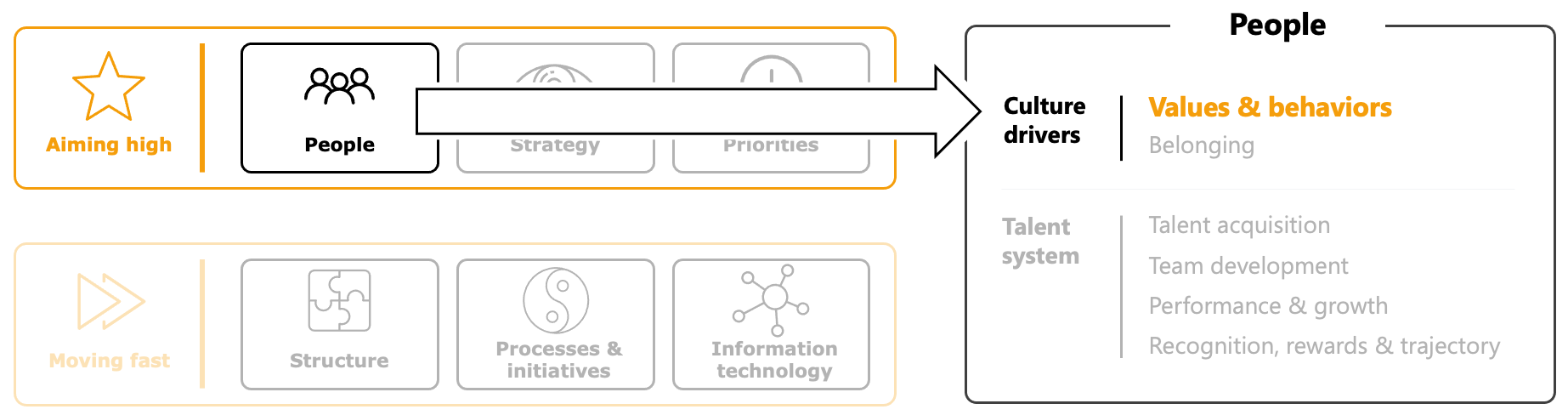
To ingrain your chosen values and behaviors, you shape the operating system in two ways: the first is via the leaders themselves. A leader's own behavior is the most visible version of what you want to spread: what they do, others read as the real standard, far more than anything written down.
The second way is via shaping the rest of the operating system, especially the talent system: how you hire, how you assess and promote people, how positive examples are recognized and negative examples are addressed.
What leaders need to do
Start with the way that needs no system and costs nothing: what leaders do, especially in the day-to-day moments where everyone is watching whether leaders really mean what they say. There are four things you can do, and none of them happens on its own. You need to go first. And you need to mean it. If you wait for the behaviors to take hold on their own, you will wait forever.
Embody it
First, live the behaviors yourself. Through your own actions, you broadcast the real standard whether you mean to or not. People read the gap between what leaders say and what they do mercilessly.
"What you do speaks so loudly that I cannot hear what you say." – Ralph Waldo Emerson
That is why naming a behavior and not personally living it is worse than not saying anything at all. Nothing corrodes "we hold each other to high standards" faster than a leader who cannot take tough feedback themselves. Your team will not conclude that living the behavior is hard. They will conclude that it is optional.
It is of course easier to model the behaviors you already live. The hard ones are the behaviors you have committed to but not yet mastered yourself. The ones you ask the organization to grow into while you are still growing into them too. Ben Horowitz describes three ways to handle this: surround yourself with people who have the trait you lack, so it gets modeled even when you do not; make actionable rules for yourself to help you live the desired behavior; and commit to it out loud, forcing yourself to walk your talk.
Keep saying it
Second, keep naming and talking about the values and behaviors over and over again, long after you are bored of hearing it yourself. It feels redundant, but people need to hear it many times before they absorb it. They start to believe it is real only once it has been repeated consistently, from multiple people, across many different contexts. Think of yourself as the Chief Reminding Officer and treat repetition not as inefficiency but as part of the job. Stop mentioning a behavior and the organization will conclude it no longer matters.
Catch people doing it right
Third, when someone lives a behavior well, tell them. This is perhaps the most underused action in this list, but from a behavioral standpoint the most powerful: immediate, specific, positive feedback is the strongest reinforcement there is. Far better than correction, which only tells people what to stop, never what to do more of. The more concrete you are, the bigger the effect: "great job" reinforces little; "thank you for bringing this up, even though it may have felt awkward. This is exactly the ownership we want" reinforces something specific and repeatable. I believe many leaders underuse this because they think people already know, or they want to save recognition for a formal review, where it comes too late to really teach anything.
Catch people doing it wrong
Fourth, when someone does not live up to a behavior, address it. A big part of culture is set by the worst behavior you tolerate. The missed target that no one names, the star performer who steamrolls a colleague and is not called out for it. People learn what is actually accepted by seeing what you let slide.
Addressing such situations need not mean cracking down. The most effective version I have seen is almost gentle. In a discussion, when something drifts too far from what you agreed to live by, first wait: give the group every chance to catch it on its own. And then, just as everyone is about to move on, put in a single question. Not a rhetorical one, but a real, genuinely clarifying question that puts the finger on exactly the thing you should not let slip. "Sorry, do we actually know why that did not work out?" for a target quietly missed. "Just a second, can you help me understand how you mean that?" for someone throwing a colleague under the bus. This works because the meeting just wants to flow pleasantly forward, but the question creates a small, deliberate bump. Just enough friction to keep everyone on the thing they were about to let slide. The signal does not have to be loud, but it is important to send it.
The toughest test is whether you hold your best people to the behaviors, not just "everybody else". Letting a strong performer who delivers results while trampling the behaviors get away with it significantly impacts your culture. It sends the signal that the behaviors are optional for anyone valuable enough.
What the rest of the operating system needs to do
Everything discussed so far depended on one thing: a leader being in the room, noticing, and choosing to act. However, once you grow beyond a certain size, you are simply not in most of the rooms anymore. The behaviors you model, name, affirm, and correct in person do not reach the rest of the organization, because you are not there.
You therefore have to build the behaviors into the parts of the operating system that keep running when you are not around. That is mostly your talent system: how you hire, how you develop people, and how you recognize and reward them. Get the behaviors into the systems you already have. Do not build a "culture program" next to them.
Hire for it
Who you hire shapes your culture more than anything else you do. Every hire either raises the bar on the behaviors or lowers it. One senior hire who is brilliant but corrosive can undo a lot of careful modeling.
So screen for behaviors, not just skills. Before the interviews, agree on what each behavior actually looks like for that role. Then run two kinds of interviews: one that tests whether someone can do the work, and one that tests how they work, meaning whether they operate the way you want them to. Be ready to turn away real talent that fails on the behaviors. The first time you pass on someone genuinely good because of how they would operate, everybody watching understands that the behaviors are not just words. Wave that person through, and they understand the opposite.
Develop it
Once someone is in, your feedback system (check-ins, reviews, etc.) is central to ensuring people keep living the behaviors. If the behaviors are part of what your organization gives feedback on, they stay real. If you only ever give feedback on results, people learn that only the numbers count.
So put the behaviors into your organization's feedback routine explicitly. When you tell someone how they are doing, you need to talk about the behaviors too, not just the targets. And when you talk about where someone should grow, treat a behavior they could get better at the same way you would treat a missing skill. "Try giving others more space in our team discussions. I think it will make us more effective" can have a very positive impact both on the team and the person's own trajectory. Behaviors are not a soft add-on to the "real" feedback about results, they are part of it. And when that regular feedback eventually gets consolidated into a formal performance review, the behaviors need to carry into that rating too.
Reward it
That performance rating should not just stay on paper. Link it to what people actually get: recognition, money, and their trajectory in the organization, from promotions at one end to being let go at the other. This is the loudest signal of all: it is where talk turns into consequences, and people watch it far more closely than they listen to anything you say.
So the behaviors have to be part of what gets rewarded, not just the results. This becomes most crucial when it comes to who you promote. Think back to the strong performer who delivers results but runs over people to get them. Promoting this person tells everyone that the behaviors are optional.
The reverse is just as powerful. When people who visibly move up are the ones who deliver results while also living the behaviors, you give others role models to emulate. Who you reward, and above all who you promote, is the clearest statement you make about what your organization truly values.
Keeping it honest
None of this is a one-time job. The behaviors you set today will evolve as you grow and as your strategy shifts. So you need a way to ensure this evolution actually happens.
Your newest people are your best source to keep sensing where you stand. Early on, a new joiner still has outside eyes, not yet blind to what everyone inside stopped noticing long ago. So ask them, ideally as a fixed part of onboarding: what feels different from where you worked before, both better and worse? What would you have expected from our stated values and behaviors that you have not actually seen lived? Write the answers down and set them aside. Individually, these are anecdotes, but collected over a year they become a real signal about the gap between what you say and what you do.
That collection then feeds into the place to act on it: the "annual outlook" (outlined in the operating rhythm post), where you look at the bigger picture anyway. Take the behaviors back out and ask honestly how well you are actually living them. Read them against what your new joiners told you and against where your strategy is heading. Then adjust if needed: usually sharpening a behavior, sometimes dropping one that no longer fits, occasionally adding one that the next phase will demand.
More than paper on the wall
In the end, it all comes down to one thing: the behaviors have to affect what you actually do. If they do not influence who you hire, who you promote, and who you let go, then they are just decoration. A value that costs you nothing and changes no decision is an empty shell.
What makes this hard is that you need to keep these mechanisms running consistently, again and again, especially in moments when it costs you something: a deal you walk away from, a star you do not promote, a strong candidate you turn down.
To be clear, the goal is not perfection. You will never reach a state where everyone lives every behavior all the time, and that is fine. This is about getting better, not about passing a finishing line. There is no single act that installs a culture. There is only consistent action, sustained over a long time. Doing that will put your organization ahead of most.
Remember that culture is not a separate thing you build alongside the company. It is not a poster, an offsite, or a stand-alone program. It is simply the sum of what your organization actually lives and what your systems reward. That is why it cannot be added on top. It has to be built into how you operate, into your operating system.
Next, we leave the "people" element for a moment and turn to strategy, and to why you cannot just play to play, but need to play to win.
Further reading
- What you do is who you are by Ben Horowitz: The most useful book I know on how culture gets set, through what leaders do and tolerate rather than what they put on the wall.
- The advantage by Patrick Lencioni: A practical guide to building a healthy organization, in part by reinforcing culture through existing systems rather than separate programs.
I value feedback. If you see something worth challenging or improving, feel free to reach out on LinkedIn. I treat these posts as living documents and will update them over time.