Getting a grip: scanning your organization's operating system

As shared in my previous post on the "coordination headwind", things get harder when your organization grows. It becomes slower. Focus (and even agreement) on what really matters declines. Things stop fitting together, and people start saying "them" instead of "we" when talking about (other parts of) the company. The organization is pushed into reactive survival mode instead of focusing on creating great products and winning customers.
While sensing the coordination headwind is easy, it is a lot less obvious what to do about it. As mentioned in that previous post, acknowledging the headwind, talking about (common) goals, and enabling teams to work independently almost always helps. But to really get a grip on what needs fixing to counter the coordination headwind, you should scan your organization's current operating system. Diagnose before you prescribe.
"Every system is perfectly designed to get the results it gets." – W. Edwards Deming
What to look at
As discussed in my first post: Every company has an operating system, either by design or accident. There are several frameworks that help make this abstract concept tangible. The one I like best and therefore use on this blog is the operating system framework we created at u-blox.
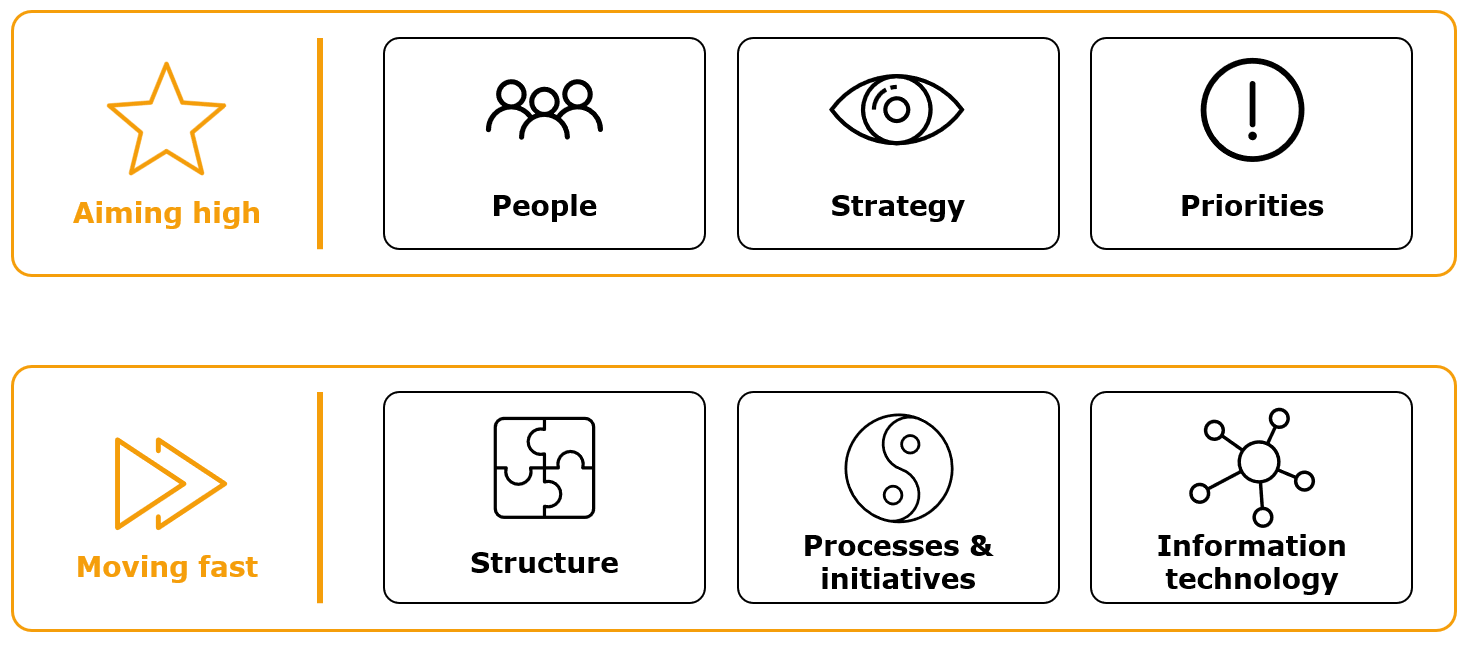
To understand the state of an organization's operating system, I find it helpful to systematically go through these six elements and check on three things each:
- Design: Do we know how this should look like?
- Awareness: Does everyone have a shared understanding of it?
- Execution: Do we follow it in practice?
These are not consecutive steps. They are different ways to look at the operating system elements: design is about what should exist, awareness about who understands it, and execution about what actually happens.
How to do it
Looking at all of this can feel like a lot, so I did my very best to make this as simple as possible (but not simpler...). Below you find the most compact version of the scan I managed to create so far. If necessary, I think you can complete it in 10 minutes. However, I believe it is worth spending more time, ideally together with your team.
Here the full scan: six elements, three lenses, 18 boxes. Together, they create a rough heatmap of where your organization's operating system supports you, and where it holds you back.
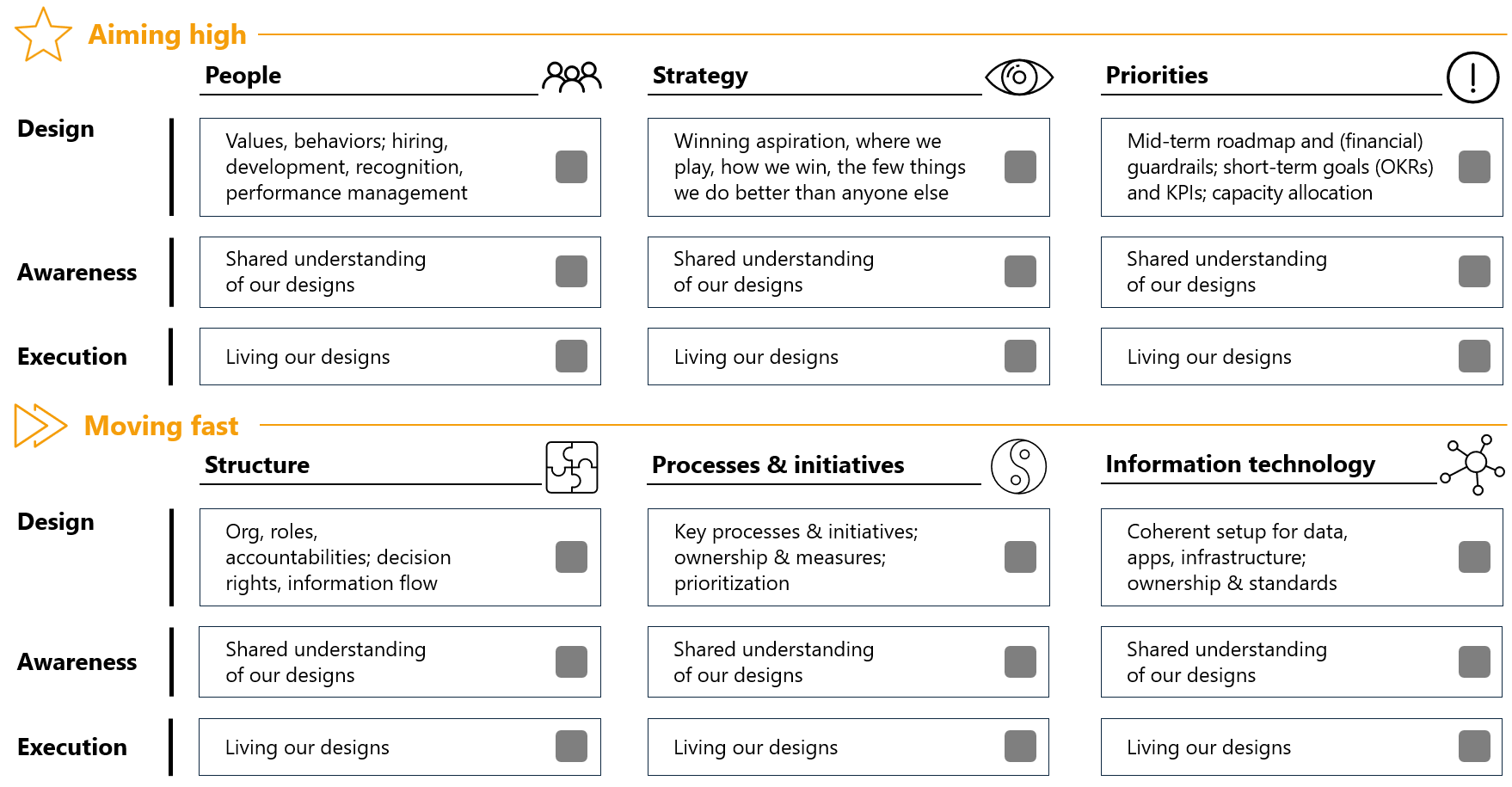
For each of the 18 boxes, go with your gut and pick a color for the small grey box:
- 🟩Green: You see no major impediments; it may even be a strength
- 🟨Yellow: You see some issues here, but they are priority 2
- 🟥Red: These are your priority 1 topics to focus on
Two things that are worth mentioning upfront:
(1) If one element's design is weak, that does not automatically mean awareness and execution are red, too. Ask instead: "Do people understand at least the few things we have? Do they live them?"
(2) Use red sparingly. Even if many topics need improvement, try to keep to three reds. If you have more, ask: "Are these all equally painful, or do a few stand out?" This will help you prioritize.
If you want to go beyond this quick scan (which I think is worth your time, but I am obviously biased), there are two good ways to do it:
- Broaden the perspective: Compare notes with others. Start with your leadership team, then expand. You will notice when insights start to mostly repeat and you can stop interviewing more people.
- Dive deeper into content: If a box feels unclear or too broad, you can dive deeper with the extended question list below. This should give you a better understanding what each element contains
Where to go from here
Reflect.
Once you have completed your scan, step back and look for patterns. Are your biggest issues concentrated in one area (e.g. priorities or people)? Are you mainly concerned about weak designs, or should your focus lie on awareness or execution?
Another question I find useful: Which issue feels like the real bottleneck – the one that would still hold you back even if everything else were perfect?
Discuss the results with your team. Emphasize that this is about continuous improvement, not distributing blame.
Focus.
Start by picking one red box that feels both important and changeable. Ask "what would it take to turn this to yellow within the next quarter?" This keeps the conversation results-oriented and constructive.
Do not try to fix too many things at once, and do not aim for perfection. The goal is to create visible progress that sticks, then move on to the next topic. As you keep growing, you may return to the same area again later.
Most organizations have quite limited capacity to drive and absorb change. It is better to complete one improvement than start five that go nowhere. Stop starting, start finishing. Create small, valuable increments.
Change.
Change is hard. Leading change is not just about finding and addressing issues, it is about helping people move forward together. That is difficult to do, which is why so many change efforts fail.
There is much more to say about this topic (and I probably will in a later post). But for now, I will leave it at mentioning that John Kotter's classic 8-step framework remains a great guide: create urgency, build a guiding coalition, form a vision, enlist volunteers, remove barriers, generate quick wins, accelerate, and make the change stick.
Block time for this work. No one will hand you the hours for these improvements, you have to claim them yourself. Otherwise, you will stay too busy sawing with a dull saw to ever sharpen it.
What comes next
After three posts on what a company operating system is, why it matters, and how you can scan for improvements, we will now get to the part I am most excited about: discussing what good looks like (at least in my view) and how to get there.
As mentioned before, I eventually want to write about all the elements that make up a high-performance operating system. But just as with improving your own OS, I cannot do everything at once, so I have to pick.
In my next post, I will write about the "Priorities" element – or more specifically, goals. Both because I think many organizations struggle here, and because small changes can often make a big difference quickly.
I am looking forward to writing about what I want to become the core of this blog: helping you build an operating system that lets your organization grow with focus, ownership, and speed. I hope to see you back here soon.
Further reading
- Where to stash your organizational risk by Will Larson: A nice overview on organizational debt, risk, and the balance of what to tackle vs. leave for now
- Our Iceberg is Melting by John Kotter: A great book about fear of change and how to motivate people to take action – all while talking about penguins :)
I value feedback. If you see something worth challenging or improving, feel free to reach out on LinkedIn. I treat these posts as living documents and will update them over time.