Operating rhythm: the pulse that drives proactivity

Many leaders (especially in rapidly growing organizations) are trapped in a reactive loop: they spend 60 hours a week fighting fires, only to realize on Friday evening that the "important but not urgent" work – people, strategy, priorities – did not get a single minute of attention.
This is not a problem of willpower or individual time management. It is a structural failure.
As companies grow, coordination stops happening naturally. Complexity grows, decisions have more trade-offs, dependencies mushroom. The coordination headwind is an unavoidable side effect of growth. Left unchecked, it erodes focus, ownership, and speed.
To retain these qualities, you need to find a way to get the "important but not urgent" work done as well. For that, do not count on sudden inspiration or on "surely finding more time in a few weeks" (for how many years have we all been telling ourselves this? has it ever happened?). I have only seen one approach work consistently: you must become deliberate about the when: when priorities are set, when a decision is forced, when an outcome is reviewed and challenged.
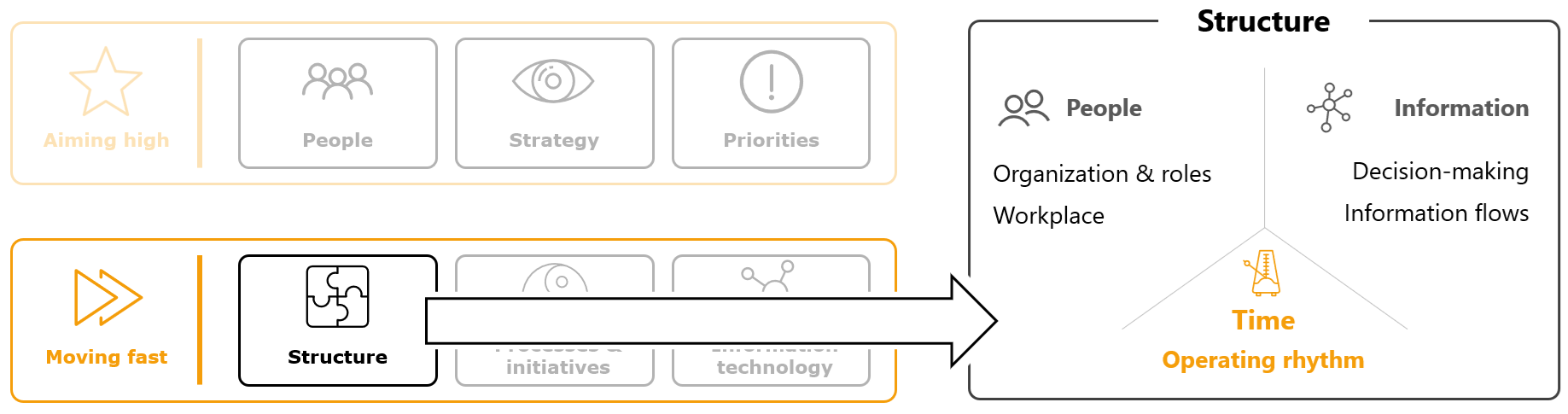
This is the role of the operating rhythm: the structure of your organization's time. The pulse that forces your organization back into proactivity.
"Good intentions don't work. Mechanisms do." – Jeff Bezos
The "more meetings" elephant
I know what you are thinking: "Are you trying to tell me I need even more meetings?"
No. I am trying to say that you are currently paying a "chaos tax": a week dominated by hundreds of reactive, uncoordinated "quick syncs", escalations, Teams messages, calls and emails.
These constant interruptions may even feel quite productive at times – you are "getting stuff done", "resolving issues", and "driving progress" – but they are a trap. They kill your ability to do deep work. And they are the reason you never have the time for the "important but not urgent" topics.
Ignoring the important eventually generates more urgent fires. This is a self-reinforcing doom loop: you do not have time for a structured, proactive rhythm due to constant firefighting. But that in turn is the very reason you are so busy fighting fires.
An effective operating rhythm replaces informal check-ins and reactive firefighting with a disciplined set of beats. By fixing the "when" of coordination, you do not add work, you consolidate it. You invest a fraction of your time – ~20% for line mangers (largely due to 1:1s) and ~10% for individual contributors – into these structured beats. This is the "coordination layer" that gives you back the rest of your week's time. What is important to understand: these beats are not "on top" of your current schedule. They replace many existing meetings, ad-hoc syncs and escalations that currently fragment your day. Done right, these beats do not just pull you out of reactivity, they are also a net-positive trade for your time.
The meeting pulse is your organization's heartbeat. [...] When people have to get something done for a meeting, they wait until the last minute and usually finish it – that's the spike. [...] At first you'll resist these regular meetings, but as soon as they become a habit, you'll embrace them. You won't know how you could have lived without them in the past." – Gino Wickman (in "Traction")
Judging meetings by their outcomes
To ensure the operating rhythm becomes effective, we have to stop seeing meetings as "time spent" and start judging them by their outcomes.
Think of every agenda item as a hypothesis: "this conversation will result in [fill the blank]". If you cannot identify that outcome upfront, remove the agenda item or cancel the meeting. If you do not achieve the outcome by the end, the meeting failed.
I believe there are only four outcomes that justify the cost of a meeting:
- Priority-setting: Deciding what matters most – and, even more importantly, what you are choosing not to do.
- Shared reality: Establishing a single, undistorted version of the truth across the organization. Note: This is to prevent the "telephone game" as information moves through organizations and layers; for simple team updates, send a summary instead.
- Decision & consequence: Resolving friction and deciding on a path forward (including "do nothing and accept the risk").
- Outcome review: Compare results against commitments to drive corrective action (e.g. moving past "why we missed" to "what we change to hit next month's target").
If an agenda item is not producing one of these, it is just noise. Cut it.
The six beats driving your rhythm
I propose structuring your operating rhythm into six recurring beats. Important upfront: you do not need to launch all six at once to see results. Pick the one where you currently feel the most friction and start from there. Doing these six beats well allows you to cancel most of the ad-hoc syncs that fragment your week. They also become the consolidated home for many of the Teams messages and emails that currently distract you. These beats do not just clean up your calendar, they silence much of the noise.
To keep the beats fast and effective, use asynchronous information flow: review the data (dashboards, written updates) ahead of the beat. If people struggle with consistent pre-reading, dedicate the first part of the meeting to silent reading, so the time together can be used for decision-making.
Beat 1: annual outlook (1 - 3 days / year)
- The goal: Step back from the daily fires to look further into the future.
- Must-have outcomes: Updated strategy, talent plan, annual goals, refined KPIs.
- Extensions: Mid-term financial planning, updated culture drivers (values, behaviors).
Beat 2: quarterly alignment (0.5 - 1 day / quarter)
- The goal: Translate strategy into execution and make resource allocation trade-offs.
- Must-have outcomes: Sharpened goals for next quarter.
- Extensions: Up-to-date project/product roadmap(s), action items derived from org health-checks.
Beat 3: monthly review (2 - 4 hours / month)
- The goal: Ensure accountability for results and confront the "run" data.
- Must-have outcomes: Corrective actions for off-track goals and KPIs, updated view on talent & hiring pipeline.
- Extensions: Assessment of (forward-looking) market opportunities and risks and sharing of (backward-looking) high- and lowlights.
Note: This beat's frequency should match your organization's "clock speed". This can range from weekly in high-velocity industries (e.g. Amazon runs weekly business reviews) up to quarterly for longer-cycle industries.
Beat 4: monthly all-hands (1 hour / month)
- The goal: Create a shared view on reality across the entire organization.
- Must-have outcomes: Organization-wide understanding on KPI results and progress on goals.
- Extensions: Celebration of wins, market and strategy updates, concrete positive examples of culture (values, behaviors).
Beat 5: Weekly team check-in (60 - 90 minutes / week)
- The goal: Maintain speed by resolving friction and unblocking the team.
- Must-have outcomes: Concrete actions to remove impediments and fix "red" metrics (both "run" KPIs and "change" goals).
- Extensions: Sync on relevant decisions made during the week, talent and hiring decisions.
Note: Some teams may prefer a bi-weekly team check-in instead.
Beat 6: Weekly 1:1 (45 minutes / week)
- The goal: Ensure individual focus, ownership, and growth.
- Must-have outcomes: Resolution of personal impediments, feedback (in both directions), alignment on weekly priorities.
- Extensions: Next steps for individual growth and career progression (e.g. quarterly).
Common operating rhythm pitfalls
Watch out for these red flags that can undermine your beats' effectiveness:
1 | The "update only" trap
Holding ourselves accountable to our promises is crucial for a high-performance organization. Comparing actual results to our plans is not bureaucracy, but central to accountability. However, you must ensure these meetings do not devolve into passive "data read-outs". If no outcomes are challenged and no trade-offs discussed, the beat may become a meeting that could have been an email.
2 | Explanation replacing decision (the "yellow" trap)
Beware the "constant yellow" status, where things are "okay enough" to avoid difficult conversations. Be equally wary when teams spend the meeting explaining why a metric is off-track (or worse, convincing themselves that the metric is not that important anyway) rather than deciding how to fix it. For example, instead of debating why a hiring target was missed, the beat should force a decision to either change the job profile or reallocate the budget. An effective rhythm forces you to regularly confront the gap between commitment and reality. It may feel uncomfortable, but it is crucial to success.
3 | Leadership bypassing the rhythm
For a rhythm to work, it must be the "single source of truth" for how the organization is coordinated. This is not an argument against the ad-hoc decisions that keep the daily engine running. However, when strategic pivots or major resource shifts happen in private chats or hallway "drive-bys", the beats lose all meaning. This creates a shadow system where an "inner circle" is in the know while the rest operates on outdated information. It also destroys accountability, because decisions are no longer traceable to an owner. Once this happens, alignment vanishes and motivation drops as people start feeling like outsiders. The rule is simple: If a decision changes the team's priorities or resource allocation, it must be brought into a beat.
4 | Meeting proliferation
It is easy to add "just one more sync" until the calendar crowds out all other work. If you find yourself adding (or accepting) a new recurring meeting, first ask: "Which of the six beats is currently not addressing this, and could we fix that instead?".
Finding your rhythm
The operating rhythm is the heartbeat of your organization. It pulls you into a synchronized pulse and with it, pushes you out of reactive mode. Do not wait for the "right" moment to start – it never arrives. Pick the one beat that addresses your biggest current friction and implement its "must-haves" this week. Once implemented, explicitly audit your calendar: Find legacy meetings that are now obsolete and cancel them.
Once fully running, expect the rhythm (including all 1:1s) to occupy ~10% of the week for individual contributors and ~20% for line managers. While that feels significant, it is one of the highest-return investments you can make. Also, this is not time added to your current schedule – doing these beats right will free up more of your time than they occupy. By spending this time intentionally, you buy back the rest of your week from the interruptions and firefighting that would otherwise dominate it.
What comes next
We have now covered the operating rhythm and goals. Next, we will look at KPIs: the measures that track how the organization is doing on delivering value.
Getting your goals, rhythm, and KPIs under control will not make every challenge disappear. You may still face hard questions about your strategy, your structure, or your talent. However, mastering these three "basics" gets you beyond survival mode. It puts you in a position where you can stop exclusively fighting fires and start building a high-performance organization.
Further reading
- Traction by Gino Wickman: A practical operating system for companies – its chapter on the "meeting pulse" outlines a disciplined rhythm (annual, quarterly, weekly) designed to turn vision into action
- The advantage by Patrick Lencioni: A foundational guide to organizational health – in "the centrality of great meetings" he explains why you must separate tactical fires from strategic alignment to eliminate "meeting stew"
- Scaling up by Verne Harnish: A systems-focused manual for high-growth companies – the "execution" section contains great thoughts on how to build an effective operating rhythm (though I disagree with his take on 1:1s)
I value feedback. If you see something worth challenging or improving, feel free to reach out on LinkedIn. I treat these posts as living documents and will update them over time.