A company's operating system: a practical model for scaling organizations

When companies scale, founders and builders often share a similar frustration: teams grow, but not much more gets done. What used to be simple and fast starts to slow down. Decisions take longer. Priorities blur. Coordination overhead rises.
We will explore why this happens in more detail in the next post. Here the short version for now: as your company grows, its operating system starts to show its limits.
Every company has an operating system, either by design or by accident. It determines how work gets done: how people coordinate, make decisions, and turn effort into results. If the operating system is strong, the organization can scale with focus, ownership, and speed. Teams stay in control, proactive, and aligned, instead of slipping into reactive firefighting.
Many leaders want to scale without descending into chaos or bureaucracy. Fewer connect that ambition to deliberately shaping the organization's operating system. But if it is not shaped deliberately, it will emerge by accident: through habits, personalities, and local optimizations. That can work early on, but scaling magnifies weaknesses. Few things derail a growing organization more reliably than a weak operating system.
I believe that if leadership teams treated the operating system with the same discipline that Finance applies to the P&L or Sales to the funnel, companies would run far more effectively. People would also enjoy working in them much more.
How to build a strong operating system (and keep it strong as your company grows) will be the core of this blog.
What a company's operating system is
First, what a company's operating system is not: it is not software. This is not about your ERP or CRM. This is also not just about your org chart. A company's operating system is broader: it is the set of elements that shape how work actually gets done in an organization.
"A system is an interconnected set of elements that is coherently organized in a way that achieves something." – Donella Meadows
People use different terms (e.g. management system, operating model) and emphasize different elements (e.g. culture, strategy, structure, processes), but they all share common themes. And while I mostly write about "the company" here, the same principles apply at any level: business units, functions, and teams. That is because a good operating system is fractal. You can start from wherever you are today.
Several models describe how organizations get work done (some linked in "further reading" below). However, when we looked for one to apply in practice at u-blox (the Swiss tech company I work for), none fit our needs well enough as-is. We therefore adapted and combined existing ideas into our own operating system framework. Below you see it in its most condensed form.
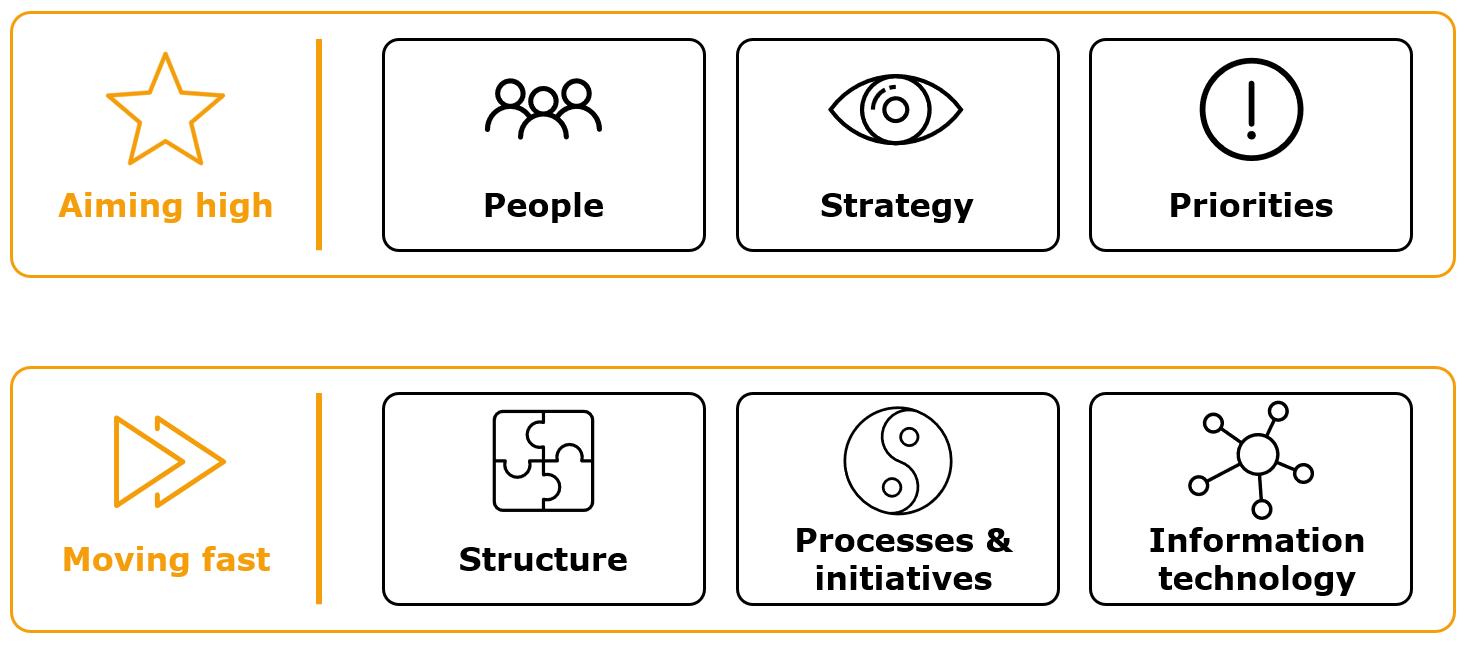
These six elements cover what matters to describe and shape how your organization gets work done. And while the interactions between these elements are important, we start by focusing on the elements themselves.
The top three help you aim high: the right people, a clear strategic direction, and focus on what matters most. The bottom three help you move fast: clear roles and decision-making, effective processes, and the right data and tools.
Over time, this blog will dive into each of these elements in detail, but as a start, here the summary:
- People: The values and behaviors that underpin your culture, and the talent system that determines who you work with
- Strategy: An integrated set of choices (including where to play and how to win) that compels desired customer action (Roger Martin's definition)
- Priorities: Your mid-term direction (guardrails and roadmap) and your most important short-term measures (KPIs) and goals (e.g. OKRs)
- Structure: How you organize people (org, roles, operating rhythm) and information (decision-making, information flow)
- Processes & initiatives: How you organize both the repeatable work ("run") and the improvement work ("change") in your organization
- Information technology: The data, applications, and infrastructure that underpin your organization
Why this becomes important once you grow
In small teams, you can get away without thinking much about the operating system. Everyone knows each other, often sits close, and roughly knows what is going on. But once you move beyond a few dozen people, this stops working. Priorities (and narratives) diverge, ownership blurs, and informal coordination breaks down.
That is the point where deliberately investing time and effort into your operating system becomes critical. Many companies miss it. And when they do, they do not just become slower and less effective, they also build up organizational debt. Like financial or technical debt, it will have to be repaid later, usually with interest.
Why I care about this
I remember my struggle 10 years ago as a freshly minted COO of a scale-up. We were around 70 people back then and I was living with the constant feeling that things were somehow slipping through our fingers. That we were not really in control. That we were constantly pushed into reactive mode, even for things that should not have come as surprises at all.
As much as I loved this job, I hated that feeling. It stressed me out. It robbed me of sleep. And I knew this issue stopped us from living up to our full potential.
I want this to become the blog I wish I had back then: something that provides structure and practical explanations for how to organize a company in the middle of scaling. How to regain control, stay on track, and increase speed. If you are building an organization and want it to scale without descending into chaos or bureaucracy, I hope this blog will be useful to you.
What comes next
This post is the starting point: outlining what a company's operating system is, why every organization already has one, and why it is worth working on deliberately.
The next post will look at "the why" in more depth: why growth often leads to complexity, slowness, and the loss of start-up mojo. And while some of this is unavoidable, why building a strong operating system can make a big difference.
Because scaling is not just about more revenue, customers, or products. It is also about ensuring that the systems underpinning your organization can keep growing with you.
Further reading
- McKinsey's 7S framework: Quite a classic among the organizational models
- Bain & Company's Operating Model: As a Bainie, this model likely had the biggest influence on my thinking
- Thinking in Systems by Donella H. Meadows: Foundational thinking for understanding systems
- Scaling People by Claire Hughes Johnson: My favorite book on company building
- Traction by Gino Wickman: Tailored to smaller organizations, but with ideas relevant at any size
I value feedback. If you see something worth challenging or improving, feel free to reach out on LinkedIn. I treat these posts as living documents and will update them over time.